



Everyone plugs in their phone before sleeping without really thinking about it. The charger is a fixed coordinate of the day – a nightstand object, a travel item, a source of low-grade anxiety on long flights. Nobody questions the two hours because the two hours have always been there.
There is no physical law that requires two hours. The two hours come from a specific choice made decades ago: lithium-ion chemistry. Change the underlying storage mechanism and the charge time changes with it.
Change it completely and the two hours become thirty seconds.
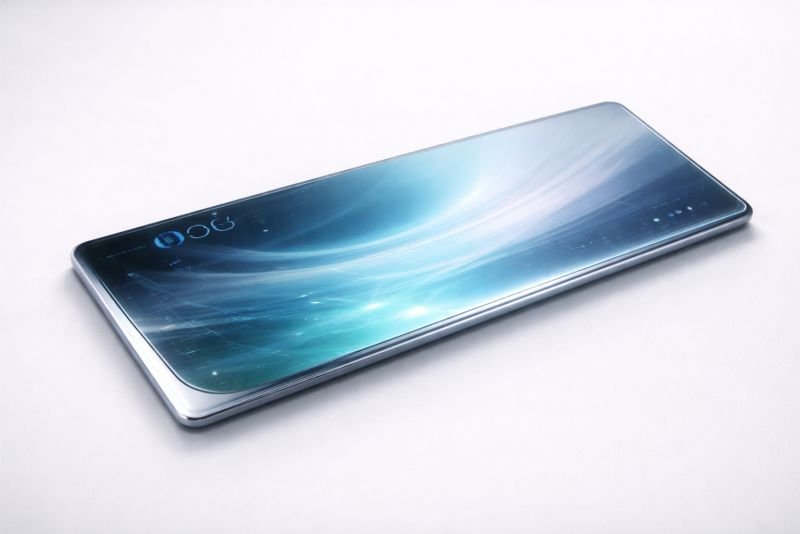
The short version: A smartphone built around a graphene supercapacitor stores energy electrostatically – no chemical reactions, no ion migration through liquid electrolyte, no electrochemical speed limit. At energy densities already demonstrated in laboratory conditions (85-100 Wh/kg), a device holding 5 Wh of usable energy accepts a full charge in under 60 seconds at a dedicated 600W charging station. The storage module cycles 500,000 times without degradation. The physics is solved. The manufacturing is not.
Key Takeaways
- Graphene supercapacitors store charge at an electrode surface – no chemical reaction means no electrochemical speed limit on charging
- A 5 Wh graphene supercapacitor phone would charge in 30 seconds at 600W, roughly the draw of a household microwave
- The storage module lasts 500,000+ cycles, meaning the phone outlives its software relevance before the power system shows wear
- A hybrid architecture pairing the graphene supercapacitor with a thin solid-state buffer cell solves the self-discharge problem the physics imposes
- The phone is the seed; the destination is a world where every surface delivers charge instantly
Table of Contents
Why Two Hours Is an Artifact, Not a Limit
The 2-hour charge time belongs to lithium-ion, not to physics. In a Li-ion cell, charging is a chemical process: lithium ions must physically migrate through a liquid electrolyte, cross an interface, and intercalate into the crystal lattice of the graphite anode. This migration takes time. Push the current too hard and lithium dendrites form – metallic needle-like deposits that pierce the separator, short the cell, and in sufficient concentration produce enough heat to ignite the electrolyte.
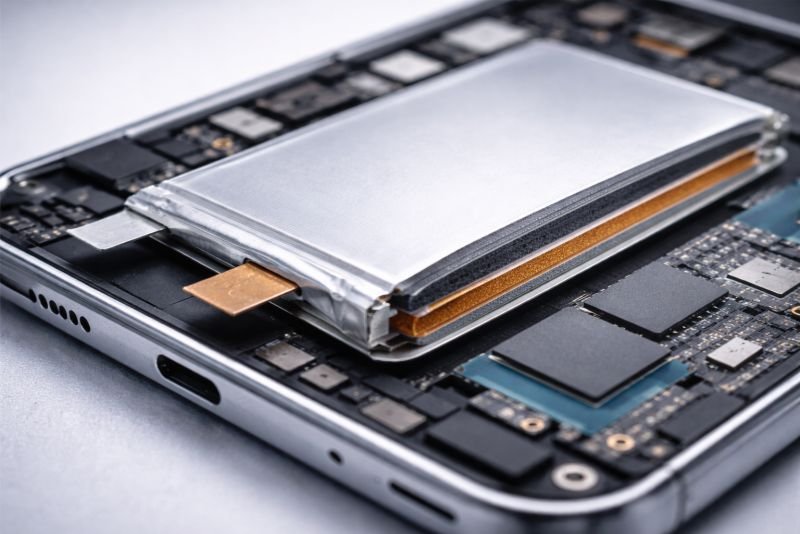
The speed limit is chemical. The ions cannot move faster without the structure breaking down.
Fast-charging technologies work around this constraint by managing temperature and ion concentration gradients carefully at different states of charge. A flagship phone reaching 120W charging has not escaped the electrochemical bottleneck. It has learned to manage it aggressively enough to bring charge time down to thirty or forty minutes while accepting measured long-term degradation. The underlying problem remains.
The graphene supercapacitor phone sidesteps the problem entirely by not using chemistry.
Graphene and the Surface Area That Changes the Math
A supercapacitor stores charge through an electric double layer. Apply voltage across an electrode immersed in electrolyte, and ions from the electrolyte arrange themselves at the electrode surface, creating a charge separation. No material is transformed. No reaction occurs. Charge time is governed by how fast current can flow through the circuit.
The traditional obstacle to supercapacitors in phones is energy density. A conventional activated-carbon supercapacitor stores 5-10 Wh per kilogram. A Li-ion battery stores 150-250 Wh/kg. A phone built around a conventional supercapacitor of equivalent total energy would be heavier by a factor of 15 to 25. That is not a phone. That is a brick with a screen attached.
Graphene addresses this directly. Its theoretical specific surface area is approximately 2,630 m² per gram – the highest of any known material. Because energy stored in a supercapacitor scales with electrode surface area, a graphene electrode packs orders of magnitude more charge capacity into the same mass as activated carbon. Laboratory demonstrations of graphene-based supercapacitors have reached energy densities of 85-100 Wh/kg. Still below Li-ion’s peak, but close enough to build a workable device if the device is designed around a different usage model.
Why graphene specifically: activated carbon has surface area but mediocre electrical conductivity. Metals have good conductivity but negligible surface area per gram. Graphene holds both properties simultaneously. At current laboratory performance figures, no other candidate material matches it on this combination.
How the Device Could Operate
The device described here uses a hybrid architecture. A graphene supercapacitor array serves as the primary storage medium, paired with a thin solid-state secondary cell occupying less than 5% of the device’s total internal volume. Each component does what the other cannot.
The Charging Math
A standard mid-range phone carries 14-15 Wh of battery capacity. At 85 Wh/kg energy density and a storage module mass of roughly 59 grams – comparable to today’s battery module – a graphene supercapacitor phone stores approximately 5 Wh of usable energy.
At 5 Wh usable storage, charge time follows a direct relationship:
t = (E / P) x 3600 seconds
Where E is energy in watt-hours and P is charger output in watts.
At P = 600W: t = (5 / 600) x 3600 = 30 seconds At P = 100W: t = (5 / 100) x 3600 = 180 seconds (3 minutes)
Six hundred watts is the draw of a household microwave oven. Delivered at 220V, it requires about 2.7 amps – within standard residential wiring capacity. The charging infrastructure is the constraint here. Current USB-C standards top out at 240W; a graphene supercapacitor phone at its theoretical charging floor needs a new connector standard. That is an engineering specification problem, solvable by the same standards bodies that defined USB-C, not a physics problem.
The Self-Discharge Architecture
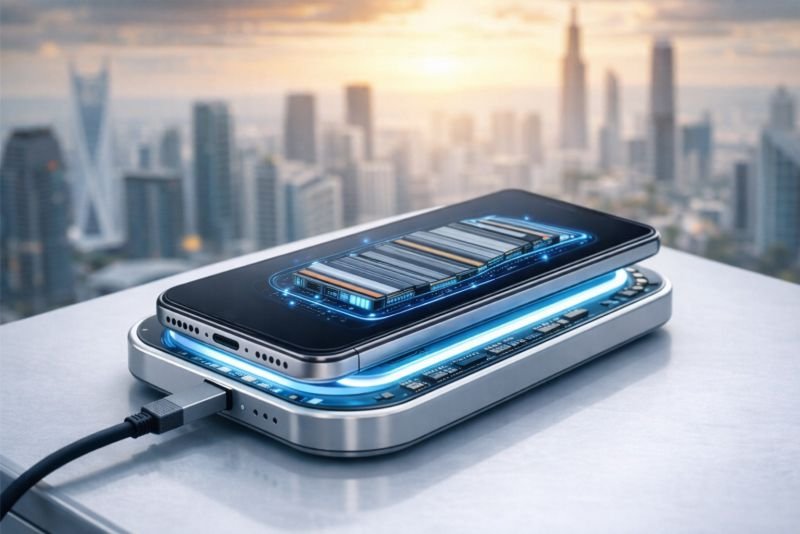
Graphene supercapacitors self-discharge faster than batteries. Conventional supercapacitors lose 10-20% of stored charge per day. Laboratory graphene designs have brought this down to roughly 5% per day – better, but still a problem for a device sitting unused through the night.
The hybrid architecture handles this directly. During active use, the graphene supercapacitor drives the device. During idle periods, it trickles charge into the solid-state secondary cell through a DC-DC converter circuit. When the phone sits unused overnight, the secondary cell maintains baseline power supply. At 5% of the supercapacitor’s total capacity, this buffer adds negligible volume and near-zero weight to the device. The dead-phone-at-7am problem disappears.
Heat at 600W and the Form Factor Question
Six hundred watts flowing into a small device raises an immediate thermal concern. The answer depends on equivalent series resistance (ESR) – the internal resistance of the storage element that determines how much charging energy converts to heat.
For a graphene electrode array, ESR values below 1 milliohm per cell are achievable in laboratory conditions. At 600W input and a nominal 4V operating voltage, charging current is 150A. Heat generated: P_heat = I² x ESR = 150² x 0.001 = 22.5W. Distributed across a graphene electrode array and conducted through a thin titanium chassis, this is comparable to the heat a phone’s processor generates under sustained load during demanding applications. Passive heat spreading handles it, no active cooling required.
As for form factor: graphene supercapacitor cells fabricate as flexible thin films. A device designed from scratch around this architecture requires no cylindrical electrode roll, no liquid electrolyte volume, no safety venting pathway. A phone built entirely around graphene film stacks could achieve the dimensions of a current flagship smartphone. Possibly thinner. The tradeoff is total energy capacity, not physical geometry – and the different charging model compensates for the smaller tank.
Everything here is free. Readers are the reason it stays that way.
I make all of it alone, with no ads. If it is worth a coffee a month to you, that keeps the next one coming.
Keep it alive →What the Device Demands Before It Exists
The graphene supercapacitor phone is not a phone with a different battery component. It demands redesign from first principles, and every downstream design decision follows from the energy model.
The Laboratory Foundation Already in Place
Research groups at institutions including MIT, the University of Manchester, and UCLA have demonstrated graphene supercapacitor cells reaching 85-100 Wh/kg and cycle lives exceeding 500,000 cycles. Flexible graphene electrode films have been fabricated at centimeter scale. The physical behaviors the device depends on have been observed and measured. What has not been achieved is consistent, large-area graphene production without performance-degrading defects.
Defects in graphene – vacancies, grain boundaries, surface wrinkles – reduce both effective surface area and electrical conductivity. In a research sample produced carefully by a specialist, defect density is controllable. In a manufacturing process producing millions of units annually, maintaining that control is the unsolved problem. The gap is the same category of gap that separated early NAND flash memory demonstrations from the storage chip inside every phone today. That gap closed because the economics and the engineering progress converged. The same convergence is the necessary condition here.
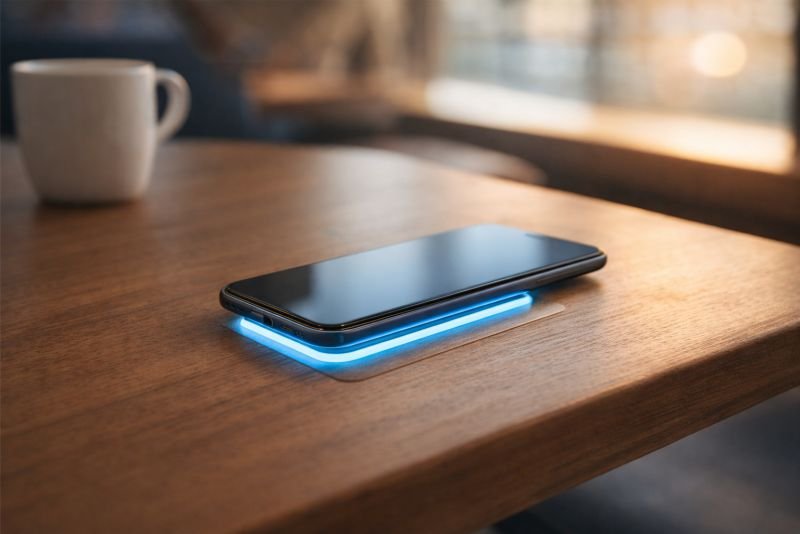
A Different Relationship With the Charger
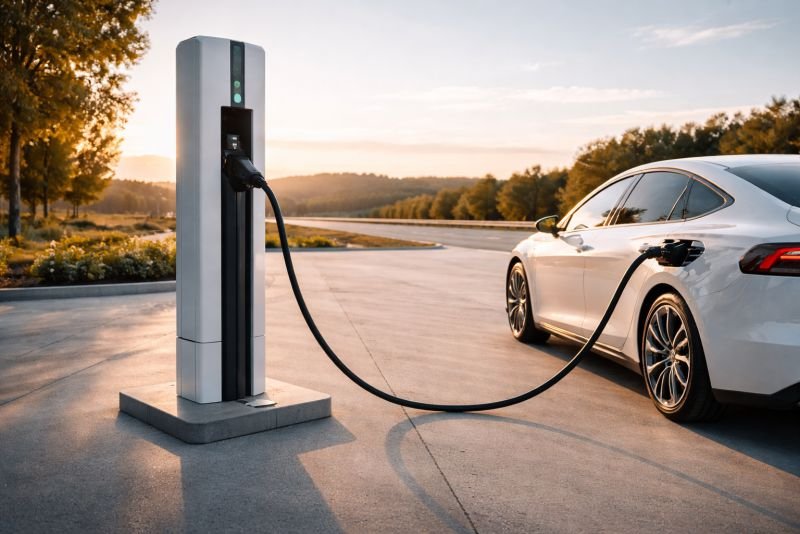
A 5 Wh device that charges in 30 seconds is a phone for a different set of assumptions about how energy moves through daily life. The user does not charge overnight. They charge whenever a surface offers contact – a desk, a transit seat, a car mount. The 30-second top-up costs less attention than reading a notification.
This restructures industrial design from the ground up. The large battery compartment disappears. The charging port, currently a compromise between data transfer and power delivery, evolves into a dedicated high-power contact optimized for 500-600W – or becomes inductive at very close range, the contact pad replacing the cable entirely.
Cycle Life and What It Does to the Industry
A Li-ion battery degrades after 300-500 full charge cycles. Two years of daily charging and the phone holds noticeably less capacity. After three years, the degradation is often severe enough to motivate replacement. The electrode materials lose structural integrity as lithium ions intercalate and deintercalate thousands of times. This is what the electrochemical process costs.
A graphene supercapacitor cycles 500,000 to 1,000,000 times without meaningful capacity loss. At three 30-second charge events per day, that represents over 900 years of equivalent use before the storage module degrades to 80% capacity. The phone becomes obsolete for camera quality, processing speed, or software support long before the energy storage shows wear.
| Parameter | Li-ion (current) | Solid-State Battery | Graphene Supercapacitor |
|---|---|---|---|
| Energy density | 150-250 Wh/kg | 300-500 Wh/kg (projected) | 85-100 Wh/kg (lab) |
| Full charge time | 30-120 min | 10-20 min (projected) | 30-60 sec |
| Cycle life | 300-500 cycles | 1,000-5,000 (projected) | 500,000+ cycles |
| Self-discharge | <5% per month | <2% per month | ~5% per day |
| Manufacturing stage | Commercial | Pilot | Research |
| Thermal safety | Moderate risk | Low risk | Very low risk |
Solid-state batteries, also unproven at commercial phone scale, address cycle degradation and offer faster charging than Li-ion. They project 10-20 minute charge times and several thousand cycles – a significantly better battery. Graphene supercapacitors project 30-second charges and effectively unlimited cycles at the cost of energy density – a different energy model entirely. The two devices are not competing for the same technical niche.
The portable power bank market exists because Li-ion phones run out and take too long to refill in the field. In a world where 30-second top-ups are available at most occupied surfaces, carrying a 20,000 mAh brick in a bag becomes a habit without a purpose. That market – roughly $10 billion globally – has no structural adaptation available for this.
Where This Technology Goes After the Phone
The phone is the logical first application because its energy requirement – 5-15 Wh – falls within the range where graphene supercapacitors are already demonstrating viable performance in the laboratory. The phone is also a seed, and the seed is worth tracing forward.
First generation: a hybrid graphene supercapacitor phone produced with lab-grade graphene, specialty manufacturing, premium pricing, limited market. Proof-of-concept that establishes the usage model and forces the charging infrastructure question into public engineering.
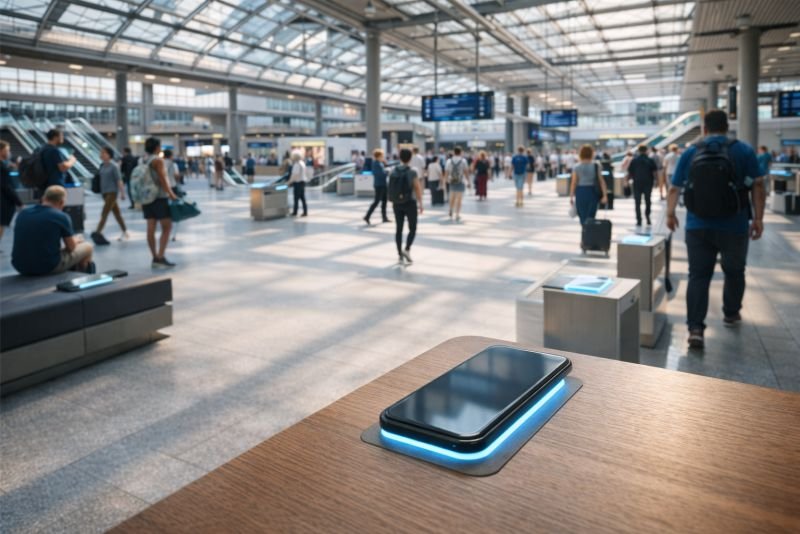
Mature generation: large-area graphene production at commercial defect tolerances, standardized 500W contact charging integrated into furniture, transit systems, and vehicles. The phone charges in 30 seconds everywhere. The user never thinks about charging.
Civilizational-scale form: every portable electronic device – hearing aids, medical monitoring controllers, smartwatches, delivery drones, AR hardware – designed around the assumption that charge is always seconds away. The device class stops being about managing energy scarcity. It becomes about making energy continuity a background condition of the built environment.
Drones are the most interesting secondary application. A drone landing on a 600W charging pad for 45 seconds and lifting off again without human intervention changes the economics of aerial operations completely. A device that recharges as fast as it lands becomes infrastructure.
The grid implication follows from scale. A million phones charging simultaneously at 600W represents 600 MW of instantaneous demand. Li-ion charging spreads this load across hours; graphene supercapacitor charging concentrates it into seconds. Grid management systems that schedule and coordinate burst charging events across buildings and city blocks become a necessary infrastructure layer – not a barrier to the technology, but an engineering consequence of it becoming widespread.
The View From NoSuchDevice
The physics is not speculative. The architecture is known. The arithmetic of charge time is straightforward. The one genuine obstacle is a manufacturing process for defect-free graphene at commercial scale, and that process has been approaching for over a decade with measurable progress each year.
What I think will be underestimated – if and when the device arrives – is the behavioral shift. People currently organize nontrivial parts of their day around battery management. They leave home at 100%. They carry cables. They compete for wall sockets in airports. They plug in overnight. All of that behavior is a response to a specific technical constraint, not to any underlying preference. Remove the constraint and the behavior evaporates, quietly and completely, the way carrying a spare camera battery now feels archaic. The technology does not just change the device. It deletes a small but persistent background anxiety from daily life.
I am less confident about the grid side. Concentrating charging loads into seconds creates demand spikes that current infrastructure was not designed to absorb. Smart charging coordination is solvable, but it requires real-time grid communication across millions of charging surfaces in buildings and city blocks – a level of systems integration the energy sector has not had to build before. This is not a reason the device cannot exist. It is the infrastructure problem the device creates on its way to becoming ordinary.
The power bank industry, for its part, will be the last to see this coming.
You read the whole thing.
That is rarer than it should be, and it is the exact kind of attention I built this archive for. I make every piece alone, with no ads and no investor deciding what gets written. If you want the next machine taken apart like this one, you can help me make it.
A coffee a month is enough to keep it free for everyone.
Prefer crypto or a one time gift? Other ways to give →