





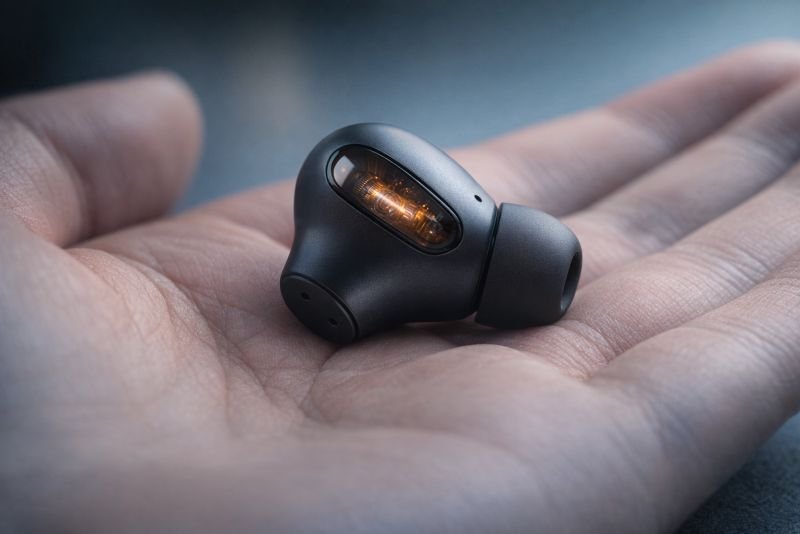
In the Human Performance Laboratory at Waseda University in Tokyo, researchers fitting subjects with MEMS accelerometers before a standard walking protocol generate a waveform that tells an interesting story. The sensor bonded to the mastoid bone, the hard protrusion directly behind the ear, records a clean oscillating signal at approximately 1.8 hertz whenever the subject moves at a comfortable pace. Vertical acceleration peaks at around 0.8 metres per second squared. The horizontal components add smaller but distinct contributions as the head bobs and sways with each stride. On a running track the amplitude grows. During stair descent it grows further. What the waveform represents is mechanical energy that enters the skull with every footstep, travels through bone, and exits as heat and vibration without doing any useful work.
Motion-powered earbuds would intercept that energy before it disappears.
The short version: Motion-powered earbuds would generate their own electricity by harvesting mechanical energy from head movements and heat energy from the temperature difference between the ear canal and surrounding air. A 3-gram proof mass oscillating at walking pace yields approximately 4 microwatts of harvestable power from kinetic harvesting alone. Today’s earbuds consume roughly 15,000 microwatts or more. Closing that gap requires advances on both sides of the equation over a 100 to 200 year engineering horizon: materials that harvest more efficiently from slow, irregular motion, and audio processing chips that consume a fraction of what current designs require.
Key Takeaways
- The human head generates a consistent mechanical waveform at approximately 1.8 hertz during walking, with peak accelerations near 0.8 m/s². That rhythmic signature is the raw energy source for the entire device.
- A realistic kinetic harvester sized for an earbud yields roughly 4 to 60 microwatts depending on activity. Current earbuds consume 15,000 to 50,000 microwatts. The gap is real, and honest arithmetic does not soften it.
- Combining kinetic harvesting with thermoelectric harvesting from the skin-to-air temperature differential at the ear canal can roughly double available power without adding meaningful bulk, and it runs continuously even when the wearer is stationary.
- Hearing aids and tactical earpieces create stronger engineering pressure for this device than consumer audio ever could. A hearing aid that never needs recharging changes medical reality in a way that convenience alone cannot motivate.
- At civilisational scale, motion-powered earbuds are the entry point for a broader concept: self-sustaining ambient computing, in which the human body provides power to a persistent layer of wearable intelligence without any external energy source.
Table of Contents
How Motion-Powered Earbuds Would Generate Energy
Two physical mechanisms work together in the device described here. The first draws on the mechanical energy of movement. The second draws on the thermal energy of the human body. Neither alone is sufficient. Together, operating with materials and architectures that current engineering cannot yet produce but known physics clearly permits, they converge on a power budget that makes the device viable.
Kinetic Harvesting from Multi-Axis Head Motion
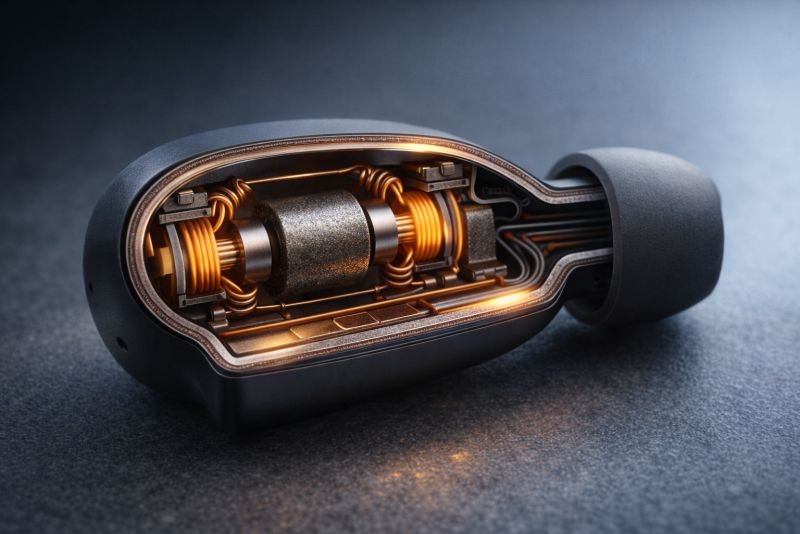
Inside the earbud housing, a small dense mass is suspended on a system designed to allow it to move independently of the housing when the head accelerates. This proof mass, most plausibly fabricated from tungsten because of its exceptional density relative to volume, sits at the core of a dual-transduction system. As the housing accelerates with every footstep and the proof mass lags behind due to its inertia, relative motion develops between mass and housing. That relative motion is the mechanical input to two harvesting layers operating simultaneously.
The first layer is electromagnetic. A precision copper micro-coil wound around the proof mass passes through a magnetic field generated by a permanent magnet fixed to the housing wall. As the mass oscillates relative to the magnet, the changing magnetic flux through the coil generates a small alternating voltage. The second layer is piezoelectric. Thin films of PVDF, a flexible piezoelectric polymer, line the suspension elements connecting the proof mass to the housing frame. When those suspensions flex under oscillatory loading, the crystalline structure of the PVDF distorts and generates electrical charge across its surfaces. Using both mechanisms simultaneously from a single proof mass motion doubles the electrical yield without adding moving parts.
Head movement during walking, running, or training involves vertical bobbing, lateral sway, and rotational nodding. A gimbal-style or multi-spring suspension allows the mass to respond to all three axes simultaneously rather than privileging the dominant vertical component. This increases the proportion of available mechanical energy that the harvester can intercept across the full range of daily activity.
Thermoelectric Contribution from the Ear Canal
A second energy source is available at the earbud’s outer boundary. The ear canal maintains a temperature close to core body temperature, typically around 37 degrees Celsius. The outer surface of the earbud housing exposed to ambient air sits several degrees cooler. A temperature difference of 4 to 7 degrees Celsius exists across a distance measured in millimetres.
Bismuth telluride thermoelectric compounds generate a voltage proportional to a temperature difference across their surfaces. This is the Seebeck effect, described in full at the Thermoelectric Effect science principles article on this site. A thin thermoelectric module sandwiched between the inner surface of the earbud housing and an outer fin layer exposed to air generates a small but continuous electrical contribution as long as the device is worn. The output under realistic conditions is approximately 10 to 30 microwatts at a 5-degree differential, given the surface area available inside an earbud housing. This is not negligible. It is power delivered continuously regardless of whether the wearer is moving, sitting, or asleep.
The Physics of Power Harvesting in Motion-Powered Earbuds
To understand what the device can actually produce, it helps to follow the arithmetic. General impressions about energy harvesting tend to be optimistic. The numbers are more honest.
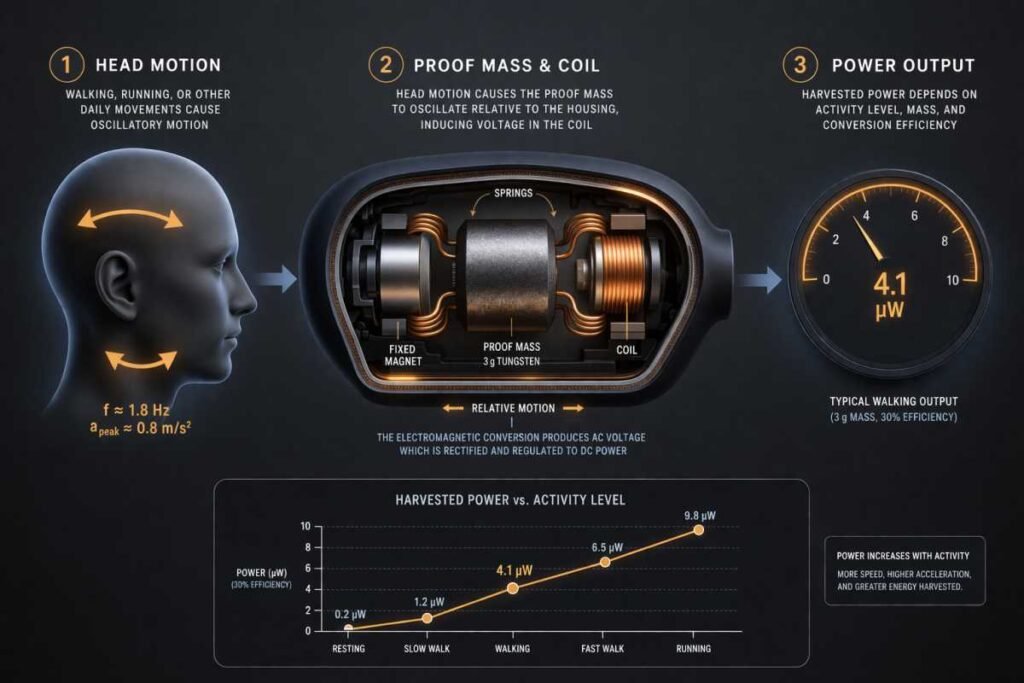
The velocity of the proof mass relative to the housing determines how much kinetic energy is available for conversion each cycle. During walking, the peak acceleration at the mastoid bone is approximately 0.8 metres per second squared at a frequency of 1.8 hertz. The peak velocity of the proof mass follows from the relationship between acceleration amplitude and oscillation frequency:
v_peak = a / (2π × f)
Where v_peak is the peak velocity in metres per second, a is the peak acceleration in metres per second squared, and f is the oscillation frequency in hertz.
Substituting the walking values:
v_peak = 0.8 / (2π × 1.8) = 0.8 / 11.31 ≈ 0.071 m/s
With this velocity established, the harvestable power from a proof mass of 3 grams and a conversion efficiency of 30 percent is:
P = η × ½ × m × v_peak² × f
Where η is conversion efficiency, m is the proof mass in kilograms, and f is the frequency in hertz.
P = 0.30 × 0.5 × 0.003 × (0.071)² × 1.8
P = 0.30 × 0.5 × 0.003 × 0.00504 × 1.8
P ≈ 4.1 microwatts
Four microwatts. A current Bluetooth earbud draws roughly 20,000 microwatts during audio playback. The arithmetic puts the gap in perspective without dramatising it.
What changes this number significantly is activity level. Running raises peak mastoid acceleration to roughly 3 metres per second squared. Substituting that value into the same formula raises harvestable power to approximately 58 microwatts under identical mass and efficiency assumptions. A multi-axis harvester capturing lateral and rotational motion components in addition to vertical bobbing increases the figure further still. And these calculations assume 30 percent conversion efficiency, which represents the performance of current PVDF films. Advanced nanofabricated piezoelectric structures already demonstrated in laboratory conditions have reached efficiencies above 50 percent. The Piezoelectric Effect article on this site explains the underlying mechanism in detail.
Everything here is free. Readers are the reason it stays that way.
I make all of it alone, with no ads. If it is worth a coffee a month to you, that keeps the next one coming.
Keep it alive →Why the Energy Budget Is the Central Problem for Motion-Powered Earbuds
The arithmetic above makes the challenge clear. What it does not make clear is why the device belongs on a 100 to 200 year horizon rather than in the “engineering problem” category. The answer is that closing the gap requires advances on both sides of the equation simultaneously, and neither side is close to its limit.
Current wireless earbuds consume 15,000 to 50,000 microwatts depending on codec, active noise cancellation, and feature load. That figure is an engineering snapshot of 2020s silicon, not a physical constant. Neuromorphic audio processing chips, which encode and decode sound using spike-based computation loosely modelled on biological neural systems, have demonstrated sub-milliwatt operation in research settings. The trajectory points toward audio processing at a few hundred microwatts for sustained listening tasks. Wireless transmission protocols a century from now will bear little resemblance to Bluetooth, and their power requirements are not constrained by anything demonstrated today.
What happens when millions of self-powered earbuds exist? The energy accounting shifts from the individual device to the population. A person wearing motion-powered earbuds during an average day of movement generates and consumes power in a local loop that never touches a charging cable. Scaled across hundreds of millions of wearers, the aggregate effect on consumer battery manufacturing, rare earth mining for battery chemistry, and electronic waste from disposable battery cells is measurable. The device changes not just the user’s relationship to charging but the upstream materials chain that charging currently requires.
The table below compares the three energy mechanisms available inside the device, the physical conditions each depends on, and the realistic output range each provides.
| Harvesting Mechanism | Energy Source | Typical Output per Earbud | Active When Stationary? |
|---|---|---|---|
| Electromagnetic induction | Kinetic: head movement | 4 to 60 microwatts | No |
| Piezoelectric film (PVDF) | Kinetic: structural flex | 2 to 20 microwatts | No |
| Thermoelectric (Seebeck) | Thermal: skin-to-air gradient | 10 to 30 microwatts | Yes |
The thermoelectric layer is the baseline. It operates whenever the device is worn, regardless of physical activity. The kinetic layers activate during movement and scale with intensity. A wearer sitting still for an hour draws down stored reserves. A wearer walking for an hour replenishes them. The device is not a perpetual motion machine. It is an energy accounting system where daily inputs and daily outputs must balance over time.
What the Internal Architecture of Motion-Powered Earbuds Would Require
The physics permits the device. The engineering specifies what must actually be built to realise it, and the internal architecture involves more coordinated design than any single component suggests.
Proof Mass, Suspension, and Transduction
The proof mass occupies the largest single volume inside the harvesting system. Tungsten is the rational choice: at 19,300 kilograms per cubic metre, it packs more inertial mass into a smaller space than any common structural metal. A tungsten cylinder of 4 millimetres diameter and 5 millimetres length masses approximately 3 grams while occupying less than one tenth of a cubic centimetre.
How does the suspension work? It must allow the mass to oscillate freely at the frequencies generated by human movement, roughly 1 to 10 hertz, without mechanical resonance at frequencies that would cause discomfort or structural fatigue over years of continuous wear. Magnetic levitation suspensions, in which permanent magnets oriented repulsively hold the proof mass away from the housing walls without any physical contact, eliminate mechanical wear entirely. The mass floats. Nothing rubs. The harvesting elements experience only electrical loading rather than mechanical friction, which has direct consequences for device longevity.
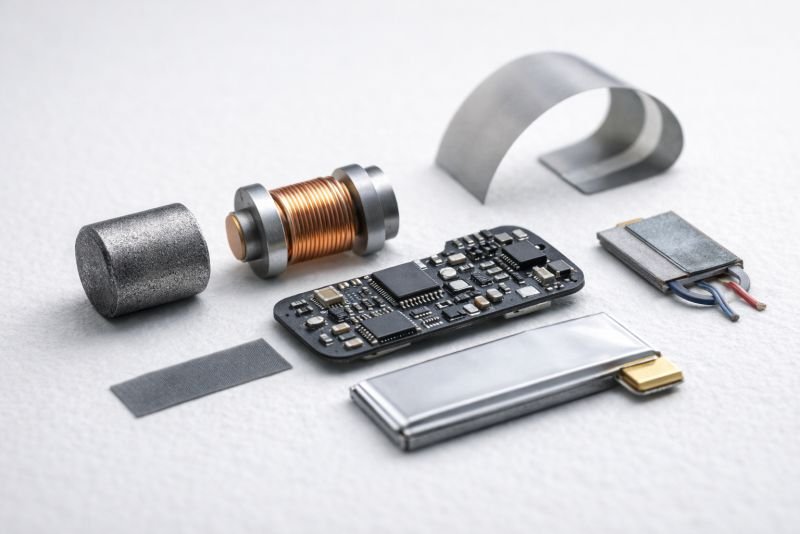
The housing material is part of the harvesting system, not just its container. A rigid structural shell transmits skull vibration directly into the proof mass mechanism rather than absorbing it. Vibration-isolating ear tip materials at the skin interface prevent discomfort without damping the input signal reaching the harvesting core.
Power Management and Storage
Raw electrical output from kinetic and thermoelectric harvesters is low-voltage, irregular, and alternating in character. A dedicated power management integrated circuit converts this to stable direct current, matches impedance between the harvesting elements and the storage medium, and allocates power between immediate audio consumption and reserve storage. The storage element combines a supercapacitor for rapid charge acceptance during high-activity bursts with a thin-film solid-state battery for longer-term capacity. Solid-state batteries use no liquid electrolyte, which makes them compatible with the miniaturisation demands of earbud geometry and resilient to the continuous charge-discharge cycling that a harvesting-based power system generates.
Ultra-Low-Power Audio Processing
Audio processing is the dominant power consumer in any earbud, and it is the variable that must shift most dramatically for the device to function. Research into neuromorphic audio chips has demonstrated that sparse, event-driven computation can reduce processing energy by one to two orders of magnitude compared to conventional digital signal processors. A future earbud that processes audio neuromorphically and transmits over a near-field successor to Bluetooth could plausibly operate below 500 microwatts for steady listening. Combined with the multi-source harvesting figures above, that is the convergence point the device requires.
The Evolutionary Arc of Motion-Powered Earbuds
The path from current harvesting research to the device described here is not a single step. It is a progression where each generation solves a specific part of the equation and creates the conditions for the next.
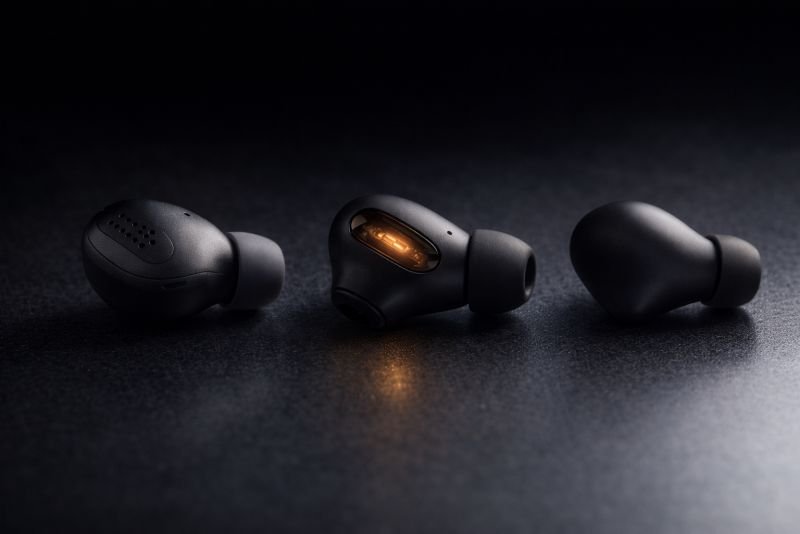
The first generation of motion-powered earbuds does not eliminate battery dependence. It reduces it. Earbuds fitted with kinetic and thermoelectric harvesters extend operational life during physical activity, recovering meaningful charge during a morning run or a commute on foot. This form generates the engineering data, the manufacturing scale, and the commercial investment that the next step requires. Measurable improvement over existing products is the proof of principle that funds the research into components that do not yet exist.
The second generation is where the gap closes. As audio processing power consumption falls through successive generations of neuromorphic silicon, and as harvesting efficiency improves through better piezoelectric materials and multi-axis architectures, the two curves converge. The charging cable disappears from the product entirely. This transition is not sudden. It is the end state of parallel engineering tracks developing independently over decades and arriving at compatibility.
The third form changes the larger picture. A self-powered audio device is an established platform. Adding biometric sensing, environmental monitoring, or spatial computing to a device that already manages its own energy budget costs less power than the harvesting system can provide. At that point the earbud ceases to be primarily an audio device. It becomes a persistent, body-powered computing node that produces sound as one of several functions. When devices of this kind exist at the ear, wrist, fingertip, and chest simultaneously, the human body becomes a distributed energy source for a continuous ambient computing layer. None of that architecture requires physics that is not already understood.
Motion-Powered Earbuds in Practice: Where the Technology Matters Most
Consumer audio is the obvious application. It is not where the engineering pressure to build this device is strongest.
Hearing Aids That Never Need Charging
A hearing aid is worn 14 to 18 hours a day. Its wearer is often elderly, may have reduced manual dexterity, and depends on the device in a way that an audio enthusiast does not. Battery management is a significant quality-of-life burden for hearing aid users worldwide: small batteries changed weekly, contacts that corrode, charging cases lost or forgotten. A device that harvests energy continuously from the wearer’s own movement and body heat, and maintains charge through ordinary daily activity, removes that burden without asking the wearer to change any behaviour. The power consumption of a hearing aid is also substantially lower than a feature-heavy consumer earbud, which means the harvesting supply-demand arithmetic is more favourable here than in any other application. Hearing aids are the most plausible first deployment category for a working version of this device.
Tactical Earpieces in Field Conditions

A soldier or special operations team member operating in the field for days or weeks faces an energy supply problem that conventional batteries cannot cleanly solve. Every piece of electronic equipment requires either battery resupply, which adds logistical weight and supply chain vulnerability, or field recharging, which requires infrastructure that may not exist. A tactical earpiece that generates its own power from movement never becomes an operational liability. It does not go flat during extended deployment. The value of that property in a military context is not primarily about convenience. It is about independence from supply chains that can be disrupted. The physical demands of military activity also mean higher levels of movement, which increases kinetic harvesting output above the figures calculated for ordinary walking.
The Foundation of Ambient Computing
The ear is anatomically well-positioned for a permanent computing node. It receives acoustic information from the environment in all directions, sits close to major blood vessels and the temporal bone for biometric sensing, and occupies a stable fixed position on the body. A self-powered device at that position, operating without any connection to charging infrastructure, is a persistent sensor and processor that the wearer never has to manage. Scaled up: when self-powered devices exist at the ear, wrist, and chest simultaneously, connected wirelessly to each other and to the environment, a body-area computing network emerges that runs entirely on harvested body energy. The individual earbud seeds that architecture. That architecture does not require new physics. It requires the engineering maturity that several converging development tracks will eventually deliver.
The View From NoSuchDevice
I think this is a genuine long-horizon device, and the reason is the size of the gap rather than its existence.
The gap between what a kinetic and thermoelectric harvester can produce from head motion and what any current earbud requires is not a gap that closes with a single breakthrough. It closes when materials science advances harvesting efficiency, when silicon architecture reduces audio processing demand by two orders of magnitude, and when wireless communication evolves beyond its current power profile. All three of those developments are individually plausible on a century-long timescale. None of them is guaranteed. Together they converge on a device that the physics already fully permits.
The hearing aid pathway is the one I find most compelling. It is the application where power requirements are lowest, daily wear duration is highest, and the human benefit of eliminating charging is clearest. If a working version of this device appears first anywhere, it will be there.
Where I am more cautious is in any assumption that kinetic harvesting alone carries the device. The thermoelectric contribution is smaller but steadier, and the combination of both sources is more robust than either one in isolation. Any version of this device that actually ships will harvest from every available physical mechanism simultaneously.
On the speculative horizon: motion-powered earbuds sit at the far end of the 100 to 200 year range, not at its near edge. The piezoelectric and thermoelectric principles are entirely real and operational today. The engineering integration required to bring them into a viable self-sustaining device depends on advances in materials, power electronics, and audio silicon that are plausible but genuinely distant. The device belongs here precisely because its physics is complete and its engineering is not. It is not speculation. It is an unfilled gap in the map of what known physics permits.
You read the whole thing.
That is rarer than it should be, and it is the exact kind of attention I built this archive for. I make every piece alone, with no ads and no investor deciding what gets written. If you want the next machine taken apart like this one, you can help me make it.
A coffee a month is enough to keep it free for everyone.
Prefer crypto or a one time gift? Other ways to give →