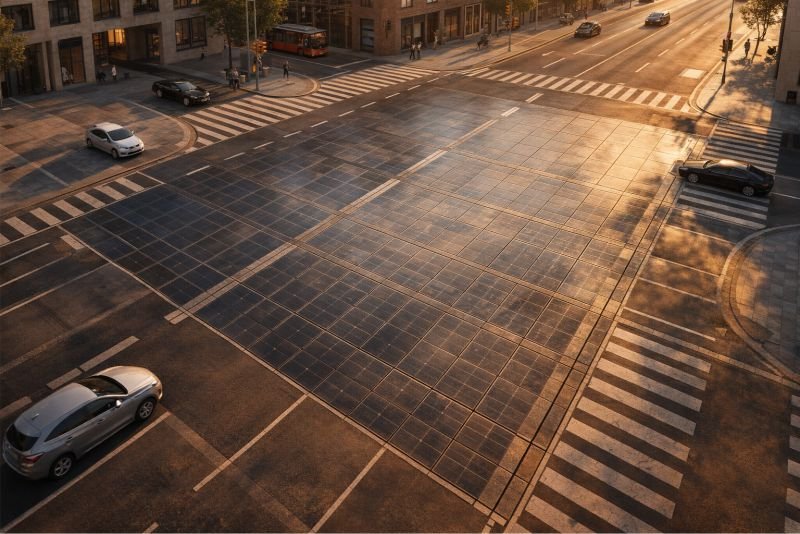






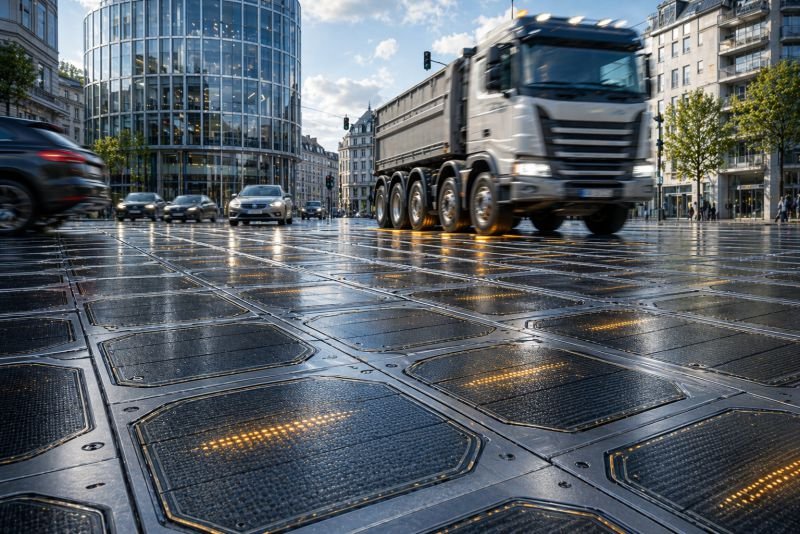
A person standing at a busy city intersection feels traffic in their feet. Not metaphorically – the pavement vibrates with each truck that passes. An articulated truck presses forty thousand kilograms into the road surface and moves on. The pavement flexes by fractions of a millimeter, springs back, and absorbs the exchange as heat. Nothing useful happens.
Multiply that event by fifty thousand vehicle passes per day. Multiply that by a hundred meters of road. Every one of those interactions involves mechanical work – force applied over a measurable distance. Roads are extremely good at absorbing it. They were engineered specifically to absorb it, without allowing any of it to do anything else.
A road kinetic energy harvester changes what happens in that fraction of a millimeter. Embedded conversion elements – piezoelectric ceramics, linear electromagnetic generators, or hydraulically coupled systems – intercept the deformation event before it becomes waste heat and route the energy into electrical output. The road surface looks unchanged. Beneath it, something is listening for the next wheel.
The short version: A road energy harvester captures mechanical work from vehicle weight passing over conversion elements embedded in the road. A fully loaded truck crossing one meter of instrumented pavement can yield over 300 joules at realistic conversion efficiency. A 100-meter single-lane urban stretch with typical daily traffic could realistically produce 25 to 30 kWh per day – enough to run its own streetlighting and feed surplus power to surrounding infrastructure.
Key Takeaways
- The energy source is vehicle deformation work – real, constant, and currently lost entirely to heat in the road surface
- Trucks dominate the output math: a heavy vehicle delivers 27 times more energy per pass than a passenger car, so vehicle mix matters more than vehicle count
- Highway speeds collapse the yield; urban intersections and speed bump zones are where this device actually belongs
- Speed bumps already justify their own existence on traffic grounds – a harvesting version adds an energy output without changing the traffic function
- The destination is not supplementing the national grid; it is a road surface that powers the infrastructure running alongside it
Table of Contents
The Weight That Goes Nowhere
Road engineering has always treated surface deformation as a problem to minimize. Pavements are designed to be stiff – to accept enormous dynamic loads and return to their original shape without measurable change. A surface that flexes visibly under traffic is failing. A surface that flexes by fractions of a millimeter under a truck and recovers immediately is behaving exactly as designed.
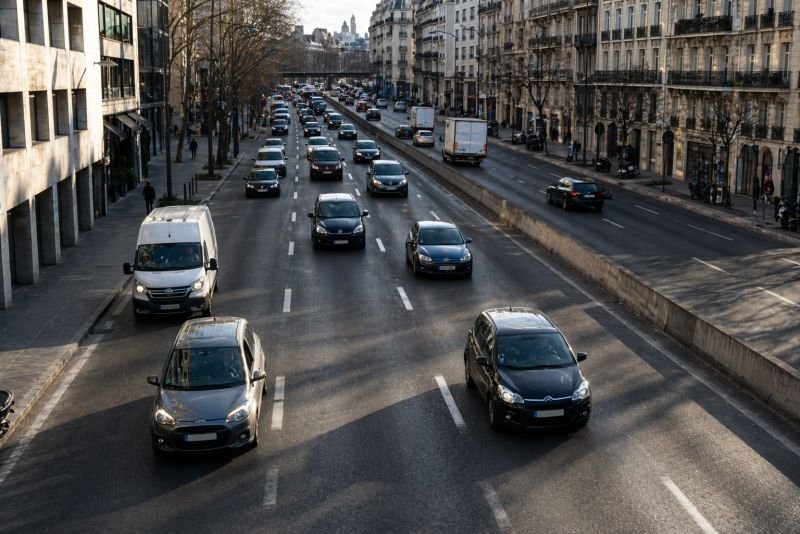
The energy budget of that exchange has never needed an account column for recovered output. A truck’s vertical wheel loading does mechanical work on the surface, the surface deflects, the elastic energy returns to the vehicle slightly degraded by rolling resistance losses, and the inelastic portion heats the pavement. Roads have always been extremely good at absorbing this work. For most of engineering history, that was the only option.
A harvesting device rewrites one line of that story. Controlled, bounded elastic deformation becomes the input to a conversion mechanism. The road is still stiff enough to carry traffic safely. The difference is that before the deformation energy dissipates as waste heat, part of it passes through a generator.
At the scale of a single vehicle pass, the numbers are unimpressive. A single car crossing a single tile produces a few joules – less than a phone screen consumes in a second. The case for this device has never rested on individual events. It rests on repetition. Fifty thousand vehicles per day. Three hundred and sixty-five days per year. A city with hundreds of kilometers of road carrying traffic at all hours. The individual event is negligible. The aggregate is worth calculating carefully.
How a Road Energy Harvester Could Operate
Capturing mechanical deformation from vehicle loading is not a single mechanism. Three physically distinct approaches can perform the conversion, each with a different relationship to vehicle weight, speed, and installation format.
Piezoelectric Elements Under Load
Piezoelectric materials – ceramics and certain polymers – generate an electrical charge when mechanically compressed. The mechanism is covered in detail in Piezoelectric Effect: How Pressure Turns Into Electricity. When a tire patch passes over a tile containing these elements, the stress event produces a charge pulse proportional to the applied force. Hundreds of elements wired in parallel across a single tile-format module raise the output to a level worth harvesting, and each vehicle generates multiple pulses as its axles pass in sequence.
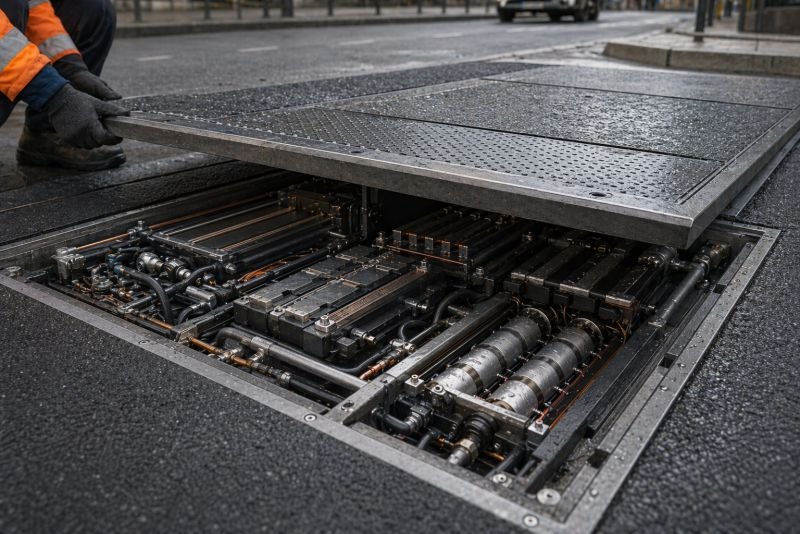
Piezoelectric conversion under realistic road loading runs at 20 to 35% efficiency – lower than electromagnetic alternatives. What the mechanism offers in exchange is structural simplicity: no moving parts, tolerance of millions of compression cycles, and a module format small enough to be swapped individually from above without disturbing the road base layer. Maintenance becomes a unit-replacement operation, not an excavation.
Electromagnetic Induction at Higher Yields
A linear electromagnetic generator works differently. Vehicle weight drives a piston or suspended mass downward, moving a coil through a magnetic field and inducing current. Energy conversion efficiency under controlled conditions reaches above 60% for electromagnetic induction – roughly double what piezoelectric ceramics deliver under comparable road loading. The gap between those two figures, multiplied across millions of vehicle passes, becomes a substantial number.
Speed is where this advantage narrows. At urban speeds of 30 to 50 km/h, a vehicle tire is in contact with a 0.5-meter tile for 40 to 60 milliseconds – enough time for a generator stroke to complete. At highway speeds of 100 to 120 km/h, the contact window drops to 15 milliseconds. The mechanism cannot complete its travel. Much of the deformation energy returns elastically and the efficiency figure collapses. Urban deployment preserves the advantage; highway deployment largely discards it.
A hydraulic approach – fluid pressurized by vehicle weight, driving a turbine or accumulator – faces the same speed problem more severely. Fluid inertia and viscosity impose response limits that make high-speed operation inefficient regardless of load magnitude. At low speeds over a deliberate surface rise, it performs reasonably well. At highway speeds, the numbers become indefensible.
Passive Tile vs. Speed Bump Format
A harvester embedded flush with the road surface captures whatever elastic deformation occurs under normal vehicle loading – small, unobtrusive, continuous. A speed bump format creates a larger displacement event by design and captures the correspondingly larger energy output.
Speed bumps already exist as traffic management infrastructure. In school zones, hospital approaches, and pedestrian-priority areas, surface discontinuities are installed specifically to force vehicles to slow. A harvesting version performs the same traffic function and produces power as a secondary output. Slower vehicles are also better energy sources at this scale, so the two purposes reinforce each other.
Speed, Weight, and the Road Harvester Energy Math
Intuitions about road kinetic energy tend to cluster in two wrong places: either it seems trivially small or it seems like it could solve urban power problems. The arithmetic ends up somewhere more specific than either assumption.
Vehicle Weight as the Dominant Variable
Using a harvesting tile with 2 mm usable displacement and 40% conversion efficiency – a reasonable figure for a mature electromagnetic system at urban operating speeds – the basic work equation gives:
E = m × g × d × η
where m is vehicle mass in kg, g is gravitational acceleration (9.8 m/s²), d is displacement in meters, and η is conversion efficiency.
For a passenger car at 1,500 kg: 1,500 × 9.8 × 0.002 × 0.40 = 11.8 J per pass
For a fully loaded articulated truck at 40,000 kg: 40,000 × 9.8 × 0.002 × 0.40 = 313.6 J per pass
The truck delivers 27 times more energy per tile crossing. On a road where trucks represent 10% of vehicles by count, they account for approximately 75% of total harvestable energy. Raw vehicle count is a misleading number. Vehicle mix is the parameter a deployment decision needs to address first.
The Boulevard Calculation
A single lane of a busy urban boulevard carries roughly 25,000 vehicle passes per day – approximately 22,500 light vehicles and 2,500 heavy. Over a 100-meter deployment with modules at one-meter intervals, the daily energy estimates by deployment context look like this:
| Deployment Context | Daily Passes | Vehicle Mix | Estimated Daily Output / 100 m |
|---|---|---|---|
| Urban boulevard (single lane) | 25,000 | 90% light / 10% heavy | 25-30 kWh |
| Speed bump zone (urban, slow) | 8,000 | Mixed, below 20 km/h | 14-18 kWh |
| Highway lane (100+ km/h) | 15,000 | High truck fraction | 8-12 kWh |
| Urban metro approach track | 400 trains | Very heavy, predictable | 30-50 kWh |
The highway figure is lower despite high truck volumes because the speed penalty on electromagnetic conversion is real and significant. The metro figure is disproportionately high because metro trains weigh 250,000 to 400,000 kg. A single train pass over one meter at the same efficiency and displacement yields roughly 3,100 J. Four hundred daily passes over a 100-meter station approach: approximately 124,000,000 J, or 34 kWh per day. From 400 events, not 25,000.
The 100-meter boulevard stretch producing 28 kWh daily powers its own streetlighting with capacity to spare. Four LED streetlights at 100 watts each, running ten hours per night, consume 4 kWh. The road surface produces seven times that.
None of that energy comes from nothing. Every joule the harvester captures was carried to that tile by a vehicle engine or battery. On a flat road at constant speed, the harvesting surface increases rolling resistance by a small amount, and the vehicle drivetrain compensates. Road users are making an invisible micro-contribution to infrastructure energy whenever they cross a harvesting zone. Whether that is a reasonable arrangement depends on what the energy powers – and whether the same vehicles benefit from it directly.
Everything here is free. Readers are the reason it stays that way.
I make all of it alone, with no ads. If it is worth a coffee a month to you, that keeps the next one coming.
Keep it alive →Where the Road Energy Harvester Belongs
The deployment question is not a secondary consideration. The difference in energy yield between the right and wrong context is large enough to determine whether this device makes sense at all.
Urban Intersections and the Speed Bump Pivot
Intersections concentrate exactly the operating conditions where a kinetic harvester performs well: reduced speeds, high vehicle frequency, and vehicles decelerating toward a stop. A vehicle moving at 20 km/h over a harvesting tile transfers more energy per pass than the same vehicle at 80 km/h – the mechanism has more time to complete its stroke, and the displacement is more complete.
Speed bump zones make the clearest case. The surface discontinuity is already installed and already justified by traffic law. Replacing a passive speed bump with a harvesting version changes nothing about the traffic management function. The harvested energy fits naturally into the immediate environment: pedestrian crossing signals, warning flashers, surveillance cameras, EV charging points at nearby parking bays. The device powers the infrastructure that already justifies its own installation.
Railway Track Approaches as the More Productive Context
Railway tracks present a deployment geometry that a road harvester engineer would specifically want. Vehicle positioning is exact and repeatable – train wheels run in fixed grooves, not across a lane-width range. Vehicle weights are extreme. Speeds in approach zones are moderate and declining. The subsurface installation environment is more controlled than public road, and modular access for maintenance is already planned into track systems.

An urban metro line entering a terminus station passes through a deceleration zone where trains slow from line speed to platform stop. Regenerative braking systems already recover part of the kinetic energy during this phase. A track-embedded harvesting system captures something different – the vertical loading deformation work as the full train weight bears on the instrumented section at low speed. Both systems operate simultaneously on separate physical phenomena and do not compete.
The grid connection question is also cleaner here. Metro systems already run on electrical infrastructure. Feeding harvested energy from the track section back into station supply requires power conditioning electronics, not new grid connections. The station becomes partly self-powered by the mechanical event of trains arriving to serve it.
From One Tile to an Active Infrastructure Corridor
A single harvesting tile produces enough electricity to charge a phone. That is not the device. The device is a coordinated corridor of modules with shared power conditioning, local storage, and a defined load it serves. Those are different engineering problems, and the path from one to the other is worth following.
Power conditioning is the first integration challenge. Raw output from individual tiles is low-voltage, pulsed, and variable – different vehicles, different loads, different speeds produce different pulse profiles across hundreds of sources simultaneously. Distributed solar installations solved a closely related aggregation problem over the last two decades, and the inverter and conditioning architectures developed for solar arrays are the most direct technical starting point for a road harvesting system. The engineering is borrowed and adapted, not invented.
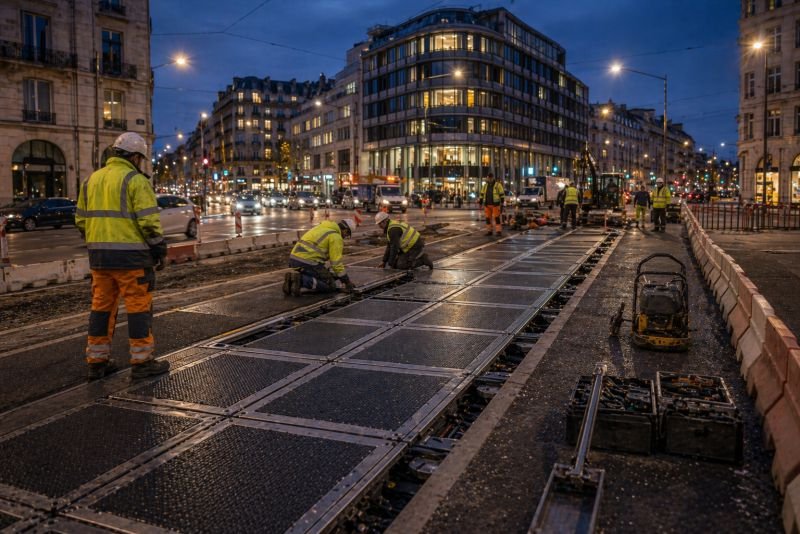
Local energy storage decouples the harvesting schedule from the consumption pattern. Traffic peaks in the morning and evening. Streetlighting demand peaks at night. Small battery banks – housed at the base of lighting columns or in roadside junction boxes – bridge that gap without requiring moment-to-moment grid balance. The road charges the storage; the storage serves the load.
Autonomous vehicles introduce one variable that changes the deployment calculus in a specific way. A vehicle with centimeter-accurate lateral positioning could be instructed to align its tire contact patches with harvesting zones at reduced speed, optimizing the energy transfer per tile crossing. Road infrastructure communicates zone locations; vehicle firmware responds. Nothing about the journey changes for the occupant. The road stops being passive substrate and becomes a cooperative energy system.
The evolutionary arc from this starting point has a clear direction, if not a clear timeline. First-generation deployment is proof-of-concept: a speed bump zone or a metro approach track, harvesting energy for the infrastructure directly around it. Mature deployment is a road that knows its own energy budget, draws on that budget for its own operations, and feeds surplus into the adjacent district grid. At civilizational scale, a city’s road network becomes a distributed power-generating surface – not replacing centralized generation, but reducing the energy burden of the infrastructure that makes dense urban living functional. Roads currently consume energy for lighting, signals, sensors, and charging points. A road that covers any meaningful fraction of that load from its own surface is a different kind of infrastructure.
The View From NoSuchDevice
I find this device more convincing in narrow contexts than as a general claim about urban energy.
The broad version – that road kinetic harvesting can make a meaningful contribution to city-scale power supply – requires a reading of the numbers that does not hold up when examined carefully. Highway deployment is a poor match for the physics. Flush urban tiles produce outputs that require very large scale to become significant in grid terms. The phrase “free energy from traffic” has been used to describe this concept, and it deserves retirement. The energy comes from fuel tanks and batteries. It is extracted from vehicle operating costs at microscale. That is not an argument against the device, but it is an argument against describing it as a passive harvest of ambient energy.
Where I think the case is genuinely strong: urban deceleration zones, speed bumps that already exist on traffic grounds, and railway track approaches to urban stations. These are not fallback positions. They are the correct deployment contexts. The physics works better there, the yields are higher, the maintenance environment is more tractable, and the captured energy returns directly to the infrastructure serving the same traffic that produced it. A metro station partly powered by the trains arriving to serve it is not a curiosity – it is a logical system.
The autonomous vehicle angle interests me because of what it represents beyond the energy output figure. A vehicle that cooperates with road infrastructure to optimize an energy transfer event has a different relationship with the surface it moves on than any vehicle has had before. Roads stop being passive. That shift – active, communicating infrastructure – carries implications across smart city systems well beyond harvesting. The kinetic energy device is, in that sense, a seed for something larger than its own output numbers suggest.
I do not expect this to become a transformative energy technology. The unit outputs are too small and the deployment complexity too real for that claim to survive contact with arithmetic. What I do expect is a class of urban infrastructure where the road surface contributes measurably to its own operational energy budget – starting with metro approaches and speed bump zones, expanding as module costs fall and autonomous positioning becomes standard. Not a revolution. An incremental claim, well-grounded in physics, that compounds at urban scale.
You read the whole thing.
That is rarer than it should be, and it is the exact kind of attention I built this archive for. I make every piece alone, with no ads and no investor deciding what gets written. If you want the next machine taken apart like this one, you can help me make it.
A coffee a month is enough to keep it free for everyone.
Prefer crypto or a one time gift? Other ways to give →