






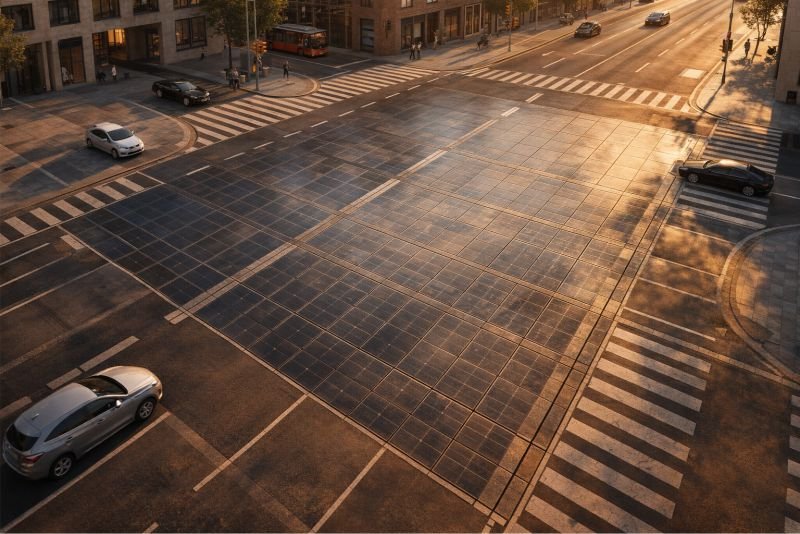
There are roughly 64 million kilometers of road on Earth. Most of them sit exposed to the sun for somewhere between four and eight hours every day, absorbing heat, expanding slightly, wearing down faster, and doing absolutely nothing productive with the radiation hitting them. A parking lot in Phoenix receives more solar energy per square meter per year than most rooftop installations in Germany. The road surface is simply not in the habit of doing anything with it.
Solar roadways propose something specific: replace the passive asphalt with a photovoltaic surface that harvests that energy. The device under consideration here is not a modified solar panel dropped onto pavement. It is a purpose-built photovoltaic road tile – structurally load-bearing, weather-resistant, electrically connected, and mechanically safe for vehicles and pedestrians alike. The question is whether a surface that does all of those things simultaneously can still do any of them well.
The short version: A solar roadway replaces conventional pavement with tempered, load-bearing photovoltaic tiles capable of generating electricity under direct vehicle traffic. A single kilometer of two-lane highway could theoretically generate 500 to 850 MWh per year – enough to power roughly 150 to 250 average European households. The physics works. The engineering constraints are substantial, and they are honest about where this device makes sense and where it does not.
Key Takeaways
- A solar road tile must simultaneously pass structural load tests, maintain electrical output, and keep surface friction above 0.4 – three goals that pull the engineering in different directions
- Horizontal photovoltaic surfaces lose 15-25% of output efficiency compared to optimally tilted panels, before accounting for shading and soiling
- Surface temperatures on exposed pavement reach 60-70°C in summer, which degrades silicon-based solar cell performance by roughly 10-25%
- Airport taxiways, parking structures, and pedestrian squares offer better first deployment geometry than high-speed highways
- The evolutionary argument for solar roads runs through urban infrastructure first, with highways as a later-stage scaling scenario
Table of Contents
The Surface That Was Already There
The interesting thing about roads is not that they are flat – it is that they are already everywhere. Every city, town, and industrial zone has invested heavily in paving, maintenance, and ownership of road surface. A device that converts that surface into a distributed energy harvester does not require new land, new rights-of-way, or new installation footprints. It inhabits infrastructure that already exists and collects rent in the form of electricity.

This is the core motivation, and it is stronger than it sounds at first. Urban rooftop solar requires roof access, structural surveys, and homeowner cooperation. Ground-mounted solar farms consume agricultural land and face community resistance. Road surfaces are publicly owned, already maintained at public expense, and physically unavoidable. If the device works at all, it scales with every kilometer of paving that already exists.
How the Photovoltaic Road Surface Works
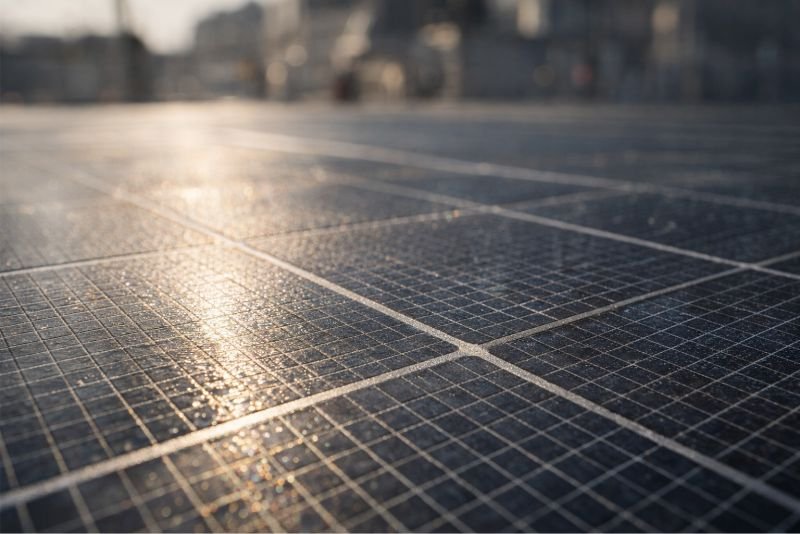
A solar roadway tile is not a single component – it is a laminated stack. From top to bottom: a tempered borosilicate glass or polycarbonate top layer engineered for both load distribution and light transmission; a photovoltaic conversion layer using monocrystalline or thin-film cells; a structural composite backing with embedded wiring; and a mounting frame that integrates with adjacent tiles and connects to subsurface conduits.
The Solar Layer Beneath the Wheels
The photovoltaic effect that drives the conversion is identical to what happens in any rooftop panel. Photons excite electrons in the semiconductor layer, generating a voltage differential across the cell. The complication is that the conversion layer in a road tile sits horizontal, often partially shaded, and behind a top surface that absorbs and reflects some incoming radiation before it reaches the cells.
A standard monocrystalline silicon cell operates at 20-22% efficiency under laboratory conditions. In a road tile configuration, two reductions apply immediately: the glass top layer transmits roughly 85-90% of incident light, and the fixed horizontal orientation means the panel never tracks the sun. On a clear day, an optimally tilted panel in central Europe captures roughly 1,000 kWh/m² annually. The same panel mounted flat on a horizontal surface in the same location captures approximately 750-850 kWh/m² – a reduction of 15-25% from geometry alone. This is not a problem to solve; it is a physical reality to account for in the arithmetic.
Modular Architecture and Grid Connection
Each tile in the described device operates as an independent generation unit with its own microinverter or DC optimizer – a design that prevents one shaded or dirty tile from dragging down the output of an entire string. On a road surface, this is not optional. Traffic patterns, parked vehicles, and tree shadows create dynamic shading that shifts hour by hour. A tile producing 15W while its neighbor produces 80W must not penalize the neighbor.
Below the tiles, pre-installed conduit channels carry low-voltage DC cables to collection boxes at regular intervals – roughly every 20 to 30 meters. From collection boxes, grid-tied inverters convert DC to AC and feed a local distribution circuit. In urban configurations, this feeds directly into the grid at the neighborhood transformer level. In isolated deployment contexts like airports or industrial parks, the output can feed dedicated storage or local loads.
Inductive Charging as a Second Revenue Stream
One extension of the base device is worth examining directly: embedding inductive charging coils beneath the driving lane to charge electric vehicles while in motion. The coils operate on the same principle as a wireless phone charger, scaled to kilowatt-range power transfer across a larger air gap. Power transfer efficiency for current coil geometries reaches 85-90% at 15-20 cm gaps, which is compatible with standard vehicle ground clearance. Adding this capability increases tile cost and stack complexity – but it creates a second function from the same road surface, and it changes the argument for highway deployment from “marginal solar gain” to “distributed charging infrastructure for the vehicle fleet using it.”
What the Surface Must Be
The most interesting engineering problem in a solar roadway is not the solar part. It is the surface part. A functional road tile must transmit light to the cells beneath, bear the full dynamic load of vehicles passing over it, and maintain traction in wet conditions. Those three requirements do not naturally cooperate.
Structural Load and the Transparency Constraint
Tempered borosilicate glass rated to 12-15 tonnes per axle is technically achievable – current glass technology used in structural floors and bridge decks demonstrates this at scale. The complication is that increasing glass thickness to meet load requirements reduces light transmission. A 15mm structural glass layer transmits around 85-87% of visible light. At 25mm, required for heavy vehicle traffic, that number drops closer to 78-82%. Thin-film photovoltaic cells, which can be deposited directly onto the glass substrate, tolerate lower light transmission better than crystalline silicon cells, making them the more plausible choice for road tile construction despite their lower base efficiency of 12-16%.
The structural frame that locks tiles together must also accommodate thermal expansion. A 1m² glass tile in a climate with seasonal temperature swings of 50°C expands and contracts by roughly 2.7mm linearly. Tile joints must absorb this movement without cracking or losing electrical contact. The solution familiar from structural glass facades – silicone-bonded expansion joints with flexible cable connectors – translates to road applications with modifications for road surface sealing and water ingress prevention.
Friction Without Sacrifice
A road surface must maintain a skid resistance value above 0.4 in wet conditions to meet minimum safety standards in most jurisdictions. A polished glass surface in wet conditions has a skid resistance of roughly 0.2-0.3 – well below the threshold. The device addresses this through surface texturing: laser etching or acid etching patterns on the top glass layer create a micro-rough surface that raises wet grip to 0.5-0.6 without meaningfully reducing light transmission. The texturing depth runs in the range of 0.1-0.3mm – invisible to the eye, tactile to the tire.
The Thermal Paradox
Road surfaces in summer are not hospitable environments for electronics. Black asphalt in direct sunlight reaches 60-70°C routinely. Silicon solar cells lose approximately 0.4-0.5% of their efficiency per degree Celsius above 25°C – the standard test temperature. At 60°C, that is a 14-17.5% efficiency penalty on top of everything else the horizontal geometry already costs.
When Heat Becomes the Problem
For a tile system operating at 15% base efficiency, the thermal penalty in peak summer conditions reduces effective output to roughly 12-13%. This is not a fatal problem – it is a design constraint that determines where the device performs best. Northern European climates, where summer paved-surface temperatures rarely exceed 40°C, lose 6-7% to heat. Desert climates lose 12-18%. The solar resource is larger in hot climates, but the efficiency penalty grows with it. The net calculation must be done per deployment, per location, not in aggregate. Anyone claiming a single global efficiency figure for solar road tiles is doing the wrong math.
Winter as an Unexpected Argument
The inversion that changes the thermal conversation comes in cold climates. Embedding resistance heating elements in the tile backing, powered by a fraction of the tile’s own output, allows the road surface to maintain above-freezing temperatures and prevent ice formation. A typical heated road segment consumes 200-300 W/m² to prevent icing. A tile in winter conditions in Scandinavia generates perhaps 50-80 W/m² on a clear day – so the heating requires supplemental grid power. But the energy to clear a surface that is also a photovoltaic generator comes with an accounting argument that conventional heated roads cannot make. In climates where winter road maintenance costs are measured in hundreds of millions annually, the self-heating road tile has an economic case that runs parallel to the electricity generation argument.
Everything here is free. Readers are the reason it stays that way.
I make all of it alone, with no ads. If it is worth a coffee a month to you, that keeps the next one coming.
Keep it alive →The Highway Arithmetic
Take a specific case: a two-lane highway section 1 kilometer long, in central Europe, receiving approximately 1,200 peak sun hours annually. The road surface width is 7.5 meters, giving a total area of 7,500 m². After subtracting road markings, expansion joints, and utility access panels, the active photovoltaic area is approximately 6,200 m².
| Parameter | Value |
|---|---|
| Active tile area | 6,200 m² |
| Annual solar resource (horizontal surface) | 950 kWh/m² |
| Tile conversion efficiency (thermal-adjusted) | 13% |
| Soiling and dynamic shading losses | 15% |
| Inverter and cabling losses | 5% |
| Net annual output | ~615 MWh |
At European average household consumption of 3,500 kWh per year, 615 MWh supplies roughly 175 households. One kilometer of highway powers 175 homes. The A1 motorway in Poland runs approximately 490 kilometers. Fully tiled in both directions, the theoretical annual output approaches 600 GWh – enough for around 170,000 households, roughly the residential consumption of a city the size of Lodz.
That number is real. It is also incomplete without the comparison: the same highway corridor, lined with ground-mounted panels on a 20-meter strip alongside the road, would produce three to four times the electricity at lower cost and with fewer engineering compromises. The solar road’s argument is not efficiency – it is footprint. The road is already there. The land beside it may not be available, or may not be public, or may face opposition. That distinction matters more than any efficiency multiplier.
Where the Device Actually Makes Sense
The honest answer to “where should solar roadways deploy first” is not highways. High-speed roads present maximum structural demands, maximum traffic-induced vibration, minimum maintenance access, and geometry problems that compound. Airport taxiways, parking lots, and urban pedestrian infrastructure offer a better first environment for the same device with different specification targets.

Airports, Parking Lots, and the Pedestrian Case
An airport taxiway handles lower speeds and more predictable loading than a public highway. A single operator controls the entire surface and has direct economic interest in system performance. Power generated on-site reduces grid dependency for airport operations. Amsterdam Schiphol Airport covers roughly 27 km² of paved surface – a partial installation on taxiways and aprons alone represents a meaningful on-site generation capacity within a single, controllable deployment context, no public road authority required.
Pedestrian squares and cycle paths offer the most favorable conditions across all the relevant parameters. Load requirements drop to a fraction of vehicle road specifications, allowing thinner glass and better light transmission. Foot traffic creates negligible soiling compared to vehicle tires. Surface geometry can be optimized slightly – a 5-degree incline on a pedestrian plaza tile is uncomfortable for nobody. In dense urban environments where rooftop access is limited and ground-mounted solar is impossible, public squares and pedestrian zones represent genuinely underutilized photovoltaic area.
The Second Function Nobody Talks About
Road tiles with intelligent drainage geometry do something asphalt cannot: they direct rainwater through controlled channels between tile joints to collection points beneath the surface, feeding gray-water systems or ground recharge infrastructure. A road that generates electricity and manages storm water is a different device from a road that only generates electricity. In water-stressed urban environments where both grid power and water management are under pressure, the double function changes the cost-benefit calculation in ways that single-function analysis misses completely.
The Evolutionary Arc
The solar roadway as a device does not deploy globally in one generation. It has a plausible growth path constrained by manufacturing capacity, installation logistics, and cost reduction curves that depend on early deployments proving the core assumptions.
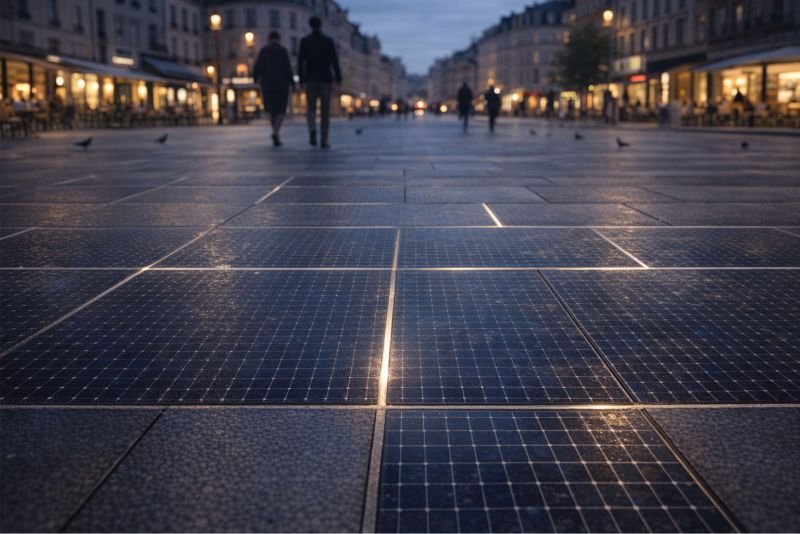
First-generation deployment concentrates on controlled, low-speed, high-value locations: industrial facility parking lots, airport aprons, pedestrian zones in cities with aggressive renewable targets. These deployments prove durability under real conditions, quantify real-world output relative to predictions, identify failure modes in tile joints and electronics, and generate the performance data that makes the second generation financially defensible.
Second-generation deployment addresses urban road infrastructure. By the time the device reaches city-street-scale deployment, the tile architecture has been refined through millions of square meters of low-speed installation. The modular replacement logistics – swapping a damaged tile in under 30 minutes without closing the road – are standard procedure. At that point, the street-level arithmetic becomes interesting not because the efficiency is competitive with ground-mounted solar, but because the installed base of urban road surface is so large that even a modest fraction represents a significant distributed generation capacity woven through the city grid.
The third-generation scenario is the one where inductive EV charging becomes standard in highway tiles. At that point, the road is not just a surface that generates power – it is the charging infrastructure for the vehicle fleet traveling over it. The energy flows in a loop: the road collects solar radiation and delivers it to the vehicles using it. What the device becomes at that scale is less a road and more a linear distributed power station that also happens to be driveable. That is a different class of infrastructure from anything currently in operation, and it arrives through incremental engineering steps, not through a single invention.
The View From NoSuchDevice
I find the solar roadway compelling for one specific reason and frustrating for another.
The compelling part is the footprint argument. Humanity has already paved over a surface area roughly the size of Egypt. That surface receives sunlight, sits in public ownership, and currently produces nothing but wear and maintenance costs. A device that converts even a fraction of that area into distributed generation does not compete with rooftop solar or solar farms for land – it occupies terrain that is already gone. That is a genuinely different proposition, and I think it gets lost whenever the conversation turns to comparing efficiency figures with conventional panels.
The frustrating part is that the efficiency comparison refuses to disappear, because it is accurate. A horizontal road tile is a worse solar collector than an optimally tilted panel. It is a worse road surface than asphalt. The engineering required to make it adequately good at both simultaneously is substantial, and the result is a device that does two things acceptably rather than one thing well. That trade-off is real, and no amount of optimistic framing changes the physics of it.
Where I think this device genuinely earns its place is in dense urban pedestrian infrastructure and controlled low-speed environments where the land footprint question is acute and load requirements are manageable. A public square in a city center is not adjacent to a field where you could put a solar farm. A highway often is. That distinction matters more than any efficiency number, and I think it is the honest basis for deciding where the first serious deployments belong.
The inductive EV charging integration is what I watch most carefully. If road tiles eventually become charging infrastructure for electric vehicles, the device stops being “a worse solar panel installed in a road” and becomes “road-integrated energy delivery for the fleet using it.” That reframing changes the economics entirely. It also changes what the device is. Whether that reframing arrives in 15 years or 40 depends almost entirely on how many airports and pedestrian squares get tiled first.
You read the whole thing.
That is rarer than it should be, and it is the exact kind of attention I built this archive for. I make every piece alone, with no ads and no investor deciding what gets written. If you want the next machine taken apart like this one, you can help me make it.
A coffee a month is enough to keep it free for everyone.
Prefer crypto or a one time gift? Other ways to give →