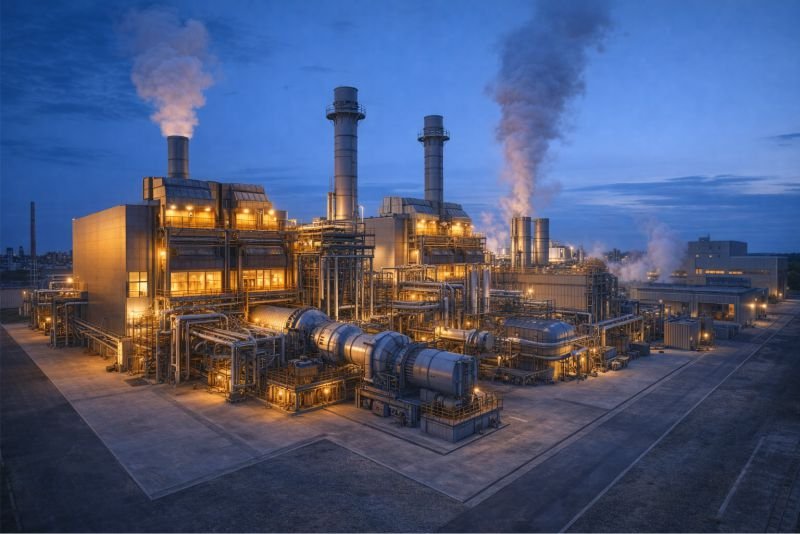






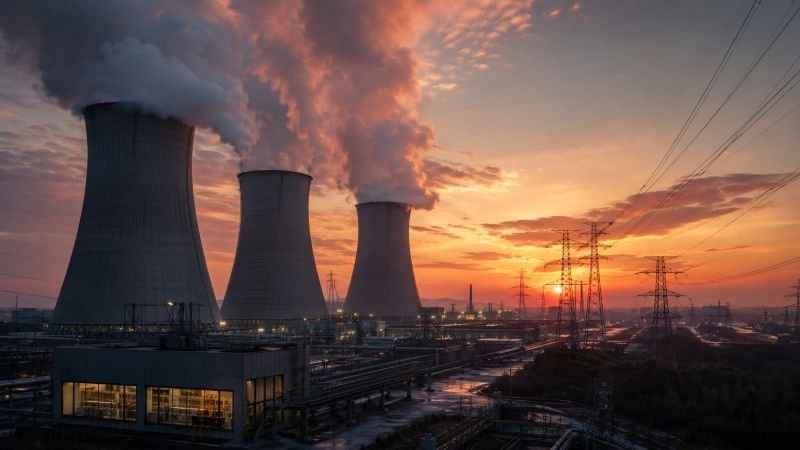
At the Belchatow power complex in central Poland, roughly 51 million tonnes of lignite burn every year to produce around 5,000 megawatts of electricity. Stand near the cooling towers on a cold morning and the thermodynamics become visible before anything else: enormous white plumes rising from structures 185 metres tall, releasing heat into the atmosphere at a rate that cannot be captured, redirected, or meaningfully reduced. The plant converts approximately 33% of its fuel’s chemical energy into useful electricity. The other 67% exits through those towers.
That 67% is not an engineering failure. It is physics behaving exactly as it always has.
The short version: The first and second laws of thermodynamics govern every energy conversion system ever built. The first law says energy is conserved: it changes form but never disappears. The second law says that converting heat into mechanical work always loses some fraction to entropy, and that loss is not a manufacturing defect but a physical requirement. Even a thermodynamically perfect heat engine operating between 600°C and 30°C can extract at most 67% of the available energy. Real systems do worse. No amount of engineering can cross that ceiling.
Table of Contents
What the First Law of Thermodynamics Says About Energy Flows
Energy moves through a power system in a way that can be tracked with considerable precision. Input arrives as chemical energy in fuel, or as kinetic energy in wind, or as radiation from the sun. Something happens inside the machine. Output leaves as electricity, or mechanical work, or heat. When engineers account for every joule entering and every joule leaving, the books always balance.
That is the first law of thermodynamics, stated plainly: energy is neither created nor destroyed. It changes form. Heat becomes mechanical motion, which becomes electrical current, which becomes light or motion again somewhere downstream. At every step in that chain, the total quantity of energy is conserved.
The practical implication for energy systems is that efficiency calculations become possible and inescapable. A coal plant burning 1,000 megajoules of chemical energy and producing 330 megajoules of electricity is not wasting 670 megajoules; it is converting them into heat that leaves through the cooling water and exhaust stack. Every one of those joules is accounted for. The first law provides the accounting framework. What it cannot do is say anything about which conversions are possible, or how much useful work a given amount of energy can deliver. For that, a second constraint applies.
Why Heat-to-Work Conversion Can Never Be Complete Under the Laws of Thermodynamics
Every power station in the world, whether it burns coal or splits uranium or concentrates solar heat, operates on the same fundamental cycle: something generates a high temperature, that heat drives a turbine or piston, and the spent heat exits at a lower temperature. The question of how much work can be extracted from that temperature difference is answered by the second law of thermodynamics.
Heat flows spontaneously from hot regions to cold ones. Work, on the other hand, requires effort to produce from heat. The second law formalises this asymmetry through the concept of entropy, a measure of how dispersed or disordered the energy in a system has become. Every real process that produces work also increases entropy somewhere. The entropy of an isolated system never decreases.
What does this mean for an energy conversion device? It means that no machine converting heat to work can avoid producing some waste heat at the cold end of the cycle. The fraction of input heat that can be converted to useful work is always less than one. That fraction is limited by the temperatures involved, not by the quality of the engineering.
Entropy as a Physical Quantity
Entropy tends to be taught abstractly, which makes it sound philosophical. The physical reality is more concrete. When fuel burns, the chemical energy that was stored in well-ordered molecular bonds disperses into the random thermal motion of combustion gases. High-temperature heat contains usable energy; low-temperature heat spread across a large mass contains the same quantity of energy in a form far harder to concentrate and use. Entropy measures that dispersal. A system at high entropy has energy distributed in ways that resist being converted back into ordered motion.
A turbine blade spinning at 3,000 revolutions per minute represents ordered kinetic energy. Steam at 600°C represents partially ordered thermal energy. The cool water in a condenser represents entropy that has nowhere useful to go. The laws of thermodynamics describe exactly how much of the first form can be extracted from the second, given the temperature of the third.
The Carnot Limit: What Temperature Alone Determines
The maximum possible efficiency of any heat engine was described by the French engineer Sadi Carnot in 1824, without knowing the precise nature of heat or the molecular basis of entropy. His result remains exact today.
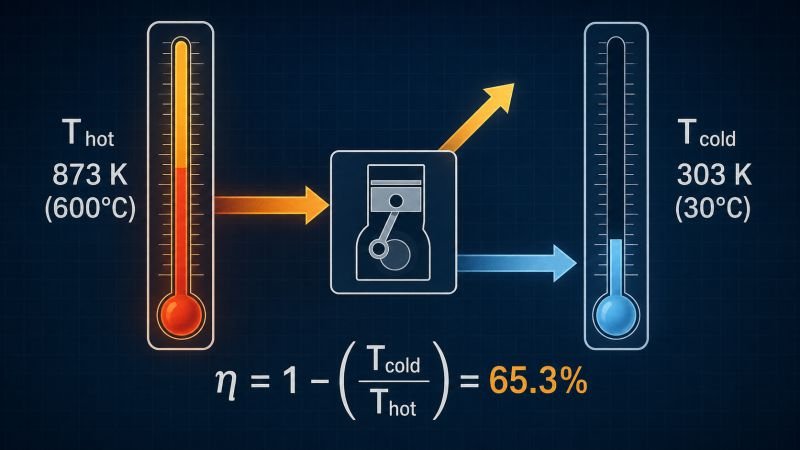
The Carnot efficiency defines the upper boundary: no heat engine operating between two temperature reservoirs can convert more than a specific fraction of input heat into work, and that fraction depends entirely on the temperatures of those two reservoirs.
η = 1 – (T_cold / T_hot)
Here, η is the maximum achievable efficiency as a decimal, T_cold is the temperature of the cold reservoir in Kelvin, and T_hot is the temperature of the hot reservoir in Kelvin. Kelvin temperatures start from absolute zero (-273.15°C), so 30°C becomes 303 K and 600°C becomes 873 K.
For a modern coal plant running steam at 600°C and rejecting heat to cooling water at 30°C:
η = 1 – (303 / 873) = 1 – 0.347 = 0.653
The theoretical ceiling is 65.3%. Physical losses in real turbines, friction, heat leakage, and irreversible combustion processes pull the actual efficiency down to around 38-45% in modern plants. The gap between Carnot’s ceiling and real-world performance is where engineering lives. Closing that gap is possible. Exceeding the ceiling is not.
The formula also explains why engineers pursue higher steam temperatures with such persistence. Raise T_hot from 600°C to 700°C, and the Carnot ceiling climbs from 65.3% to 70.7%. For a 1,000 MW plant, that improvement is worth hundreds of millions of euros per year in fuel savings. The constraint is materials: turbine blades that survive 700°C steam at 30 MPa pressure must resist creep, oxidation, and thermal fatigue simultaneously, which is why advanced nickel superalloys are central to high-efficiency turbine research.
Temperature, Pressure, and the Variables That Push the Laws of Thermodynamics to Their Limits
The Carnot equation holds two variables: hot-side temperature and cold-side temperature. Most of the engineering effort in power generation amounts to maximising the first and minimising the second within physical constraints.
Cold-side temperature is largely fixed by geography. A plant cooling with river water at 15°C does thermodynamically better than one using sea water at 28°C. This is not a trivial difference: a 13-degree improvement in cold-side temperature raises the Carnot ceiling by roughly 2-3 percentage points for a typical steam cycle, which represents a meaningful efficiency gain at gigawatt scale. Coastal nuclear plants in warmer climates carry a permanent thermodynamic penalty from this effect, regardless of reactor design.
Hot-side temperature is limited by materials. The relationship between temperature, pressure, and material limits in steam turbines defines what engineers call the Rankine cycle. Higher pressure steam carries more energy per kilogram, allowing more work extraction per unit of fuel. Ultra-supercritical steam plants, now operating at pressures above 30 MPa and temperatures above 600°C, achieve efficiencies approaching 45%, compared with 33% for subcritical plants from the 1970s. The laws of thermodynamics have not changed. The materials that allow approaching their limits more closely have improved.
| Parameter | Subcritical Plant (1970s) | Supercritical Plant (2000s) | Ultra-Supercritical (2020s) |
|---|---|---|---|
| Steam temperature | ~540°C | ~580°C | 600-620°C |
| Steam pressure | ~16 MPa | ~24 MPa | 28-35 MPa |
| Thermal efficiency | ~33% | ~38-40% | ~42-46% |
| Carnot ceiling | ~64% | ~66% | ~67-68% |
The gap between actual efficiency and the Carnot ceiling has narrowed over fifty years, but the ceiling itself has moved only slightly, because T_cold is largely fixed by ambient conditions. The real constraint is always the second law. Better materials and control systems close the distance to the ceiling. They cannot raise it.
Everything here is free. Readers are the reason it stays that way.
I make all of it alone, with no ads. If it is worth a coffee a month to you, that keeps the next one coming.
Keep it alive →Waste Heat as the Inevitable Output of the Laws of Thermodynamics
In any thermal power plant, the condenser is the component that removes the waste heat from the cycle. It exists not because engineers failed to find a better design but because the second law requires a cold reservoir. Without somewhere to dump the rejected heat, the cycle cannot run at all.
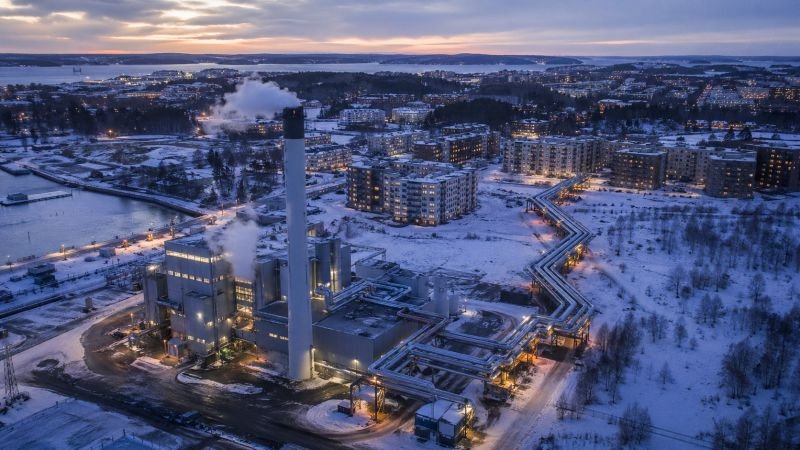
The global scale of this waste heat is striking. Worldwide electricity generation currently dumps more than 15,000 terawatt-hours of thermal energy into rivers, oceans, and cooling towers every year. That figure represents roughly two-thirds of all the primary energy used to generate electricity, released at temperatures too low to drive turbines but often high enough to heat buildings or industrial processes.
District heating systems in Scandinavia and central Europe have captured some of this energy for decades. The Fortum district heating network in Stockholm receives waste heat from the Värtaverket plant and distributes it to around 90,000 apartments. The thermodynamics have not changed: the plant still rejects heat at the cold end of its cycle. The difference is that the heat exits at a temperature useful enough for space heating, around 80-90°C, and a transmission network exists to deliver it. The energy that Belchatow sends to atmosphere, Stockholm channels to radiators.
The technical term for the useful work content of an energy flow is exergy. High-temperature heat has high exergy; low-temperature heat has low exergy. The laws of thermodynamics do not forbid using low-exergy waste heat. They only forbid converting it back into high-exergy work without paying a thermodynamic price. Combined heat and power plants, which produce both electricity and usable thermal output from the same fuel input, can achieve overall energy utilisation rates of 80-85%, even though their electrical efficiency remains bounded by Carnot.
How Engineers Design Energy Systems Around the Laws of Thermodynamics
Working within thermodynamic limits does not mean accepting them passively. Engineers have developed a set of techniques for approaching the Carnot ceiling more closely, each addressing a specific source of irreversibility in real systems.
Regeneration involves capturing heat from exhaust gases and using it to preheat incoming fluid before combustion. In a gas turbine with regeneration, the turbine exhaust preheats the compressed air entering the combustor, reducing the fuel needed to reach operating temperature and therefore raising overall efficiency. Modern combined-cycle gas turbine plants, which pair a gas turbine with a steam turbine that runs on the gas turbine’s exhaust, achieve electrical efficiencies of 60-63%. For reference, Carnot efficiency between typical combustion temperatures and ambient conditions would allow around 70-72%. The gap has narrowed considerably.
Combined Cycles and Cascaded Temperature Use
Why does combining two turbine cycles in series improve efficiency so much? Each cycle harvests work from a temperature range. A gas turbine runs between roughly 1,400°C and 600°C. That 600°C exhaust would be waste heat in a simple cycle. Feed it into a heat recovery steam generator and it becomes the heat source for a steam cycle running between 560°C and 30°C. The laws of thermodynamics allow this cascade because each cycle operates legitimately between its own hot and cold temperatures. The total work extracted is the sum of both cycles. The fuel input is the same as for the gas turbine alone.
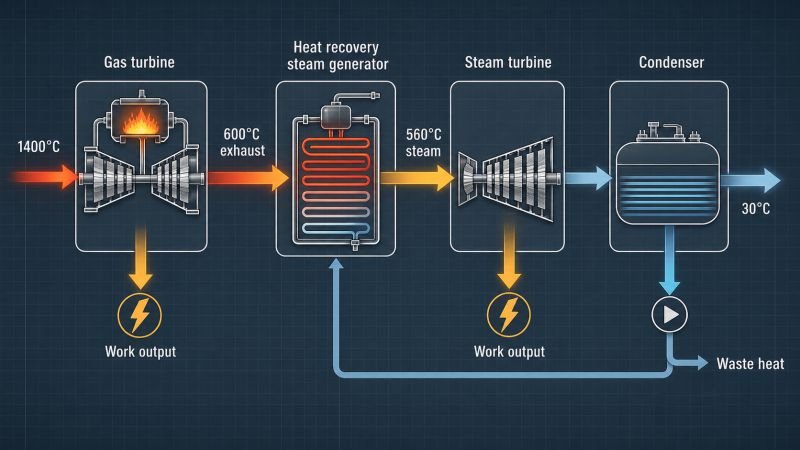
Does stacking more cycles continue to improve efficiency indefinitely? No, and for a straightforward reason. Each additional cycle harvests from a lower temperature range, where the Carnot ceiling is lower and the engineering complexity higher. Real gains diminish rapidly after two stages. Theoretical triple-cycle arrangements exist in research literature but the engineering cost of the third stage rarely justifies the marginal efficiency gain in current materials and operating conditions.
What the Laws of Thermodynamics Mean for Renewable Energy Conversion
Solar and wind energy are sometimes described as exempt from thermodynamic constraints because they do not burn fuel. The first part of that description is accurate. The second is not.
Concentrated solar power plants use mirrors to focus sunlight onto a heat receiver, generating temperatures above 500°C, then running a steam turbine through an ordinary Rankine cycle. The laws of thermodynamics apply identically. The Carnot ceiling is determined by the same temperature ratio. The engineering challenges are the same. The absence of fuel combustion does not change the fundamental thermodynamic accounting; it only changes the source of the hot reservoir.
Photovoltaic cells present a different case. They convert light directly into electrical current through the photoelectric effect, bypassing the heat-to-work conversion cycle entirely. Thermodynamic limits still apply, expressed through a different framework, the Shockley-Queisser limit, which sets the theoretical maximum efficiency of a single-junction solar cell at around 33%. Real silicon cells achieve 22-24% commercially; research cells have reached 29-30% under standard conditions. The constraint is different in mechanism from Carnot, but it is equally hard.
Wind turbines face the Betz limit: no turbine can extract more than 59.3% of the kinetic energy in wind passing through its swept area. Extracting all of the kinetic energy would require the downstream air to stop completely, which would block further flow. Modern large turbines operate at 45-50% of the Betz limit, meaning they reach roughly 75-85% of what the second-law equivalent for fluid dynamics allows. The languages differ. The structure of the constraint is the same: physics sets a ceiling derived from first principles, and engineering spends decades approaching it.
The View From NoSuchDevice
There is something clarifying about the laws of thermodynamics, once the initial frustration passes. Every energy technology eventually runs into the same wall, described by the same two equations, and the engineering conversation becomes: how close to that wall can we get? The question is not whether the limit exists. It does. The question is how many percentage points of efficiency separate the current engineering from the theoretical maximum, and whether the cost of closing that gap is worth it.
I find it more useful to frame thermodynamic limits as design constraints than as failures. A combined-cycle gas turbine running at 62% efficiency is not a machine that wastes 38% of its input. It is a machine that extracts nearly 90% of what the second law allows under real operating conditions. That is a considerable achievement, and it is not finished. Ultra-supercritical steam research, supercritical CO2 turbines, and high-temperature materials development are all active engineering fronts working on the same problem from different angles.
The cooling towers at Belchatow release heat that physics requires them to release, given the temperatures the plant operates at. The interesting question is not whether that waste can be eliminated, because it cannot, but whether the temperature at which it exits is high enough to be useful, and whether infrastructure exists to deliver it somewhere. Most of the time, in most places, the answer is currently no. That is an infrastructure and investment problem, not a physics problem. Physics already said what is possible.
The gap is elsewhere.
You read the whole thing.
That is rarer than it should be, and it is the exact kind of attention I built this archive for. I make every piece alone, with no ads and no investor deciding what gets written. If you want the next machine taken apart like this one, you can help me make it.
A coffee a month is enough to keep it free for everyone.
Prefer crypto or a one time gift? Other ways to give →
Technologies Related to This Concept
| Technology | Concept |
|---|---|
| Geothermal Energy Harvesting in Urban Foundations | Concept: Utilizing geothermal heat from deep foundations of skyscrapers. |
| Solar Thermal Facades for Heating and Electricity | Concept: Building facades that capture solar heat for direct thermal use and power generation. |
| Thermoelectric Building Materials | Concept: Materials that convert temperature differences in buildings into electricity. |
| Heat Harvesting from Subway Systems | Concept: Capturing the ambient heat in subway tunnels to generate electricity. |
| Biomass-Fueled District Heating Systems | Concept: Communities using organic waste to power heating systems. |