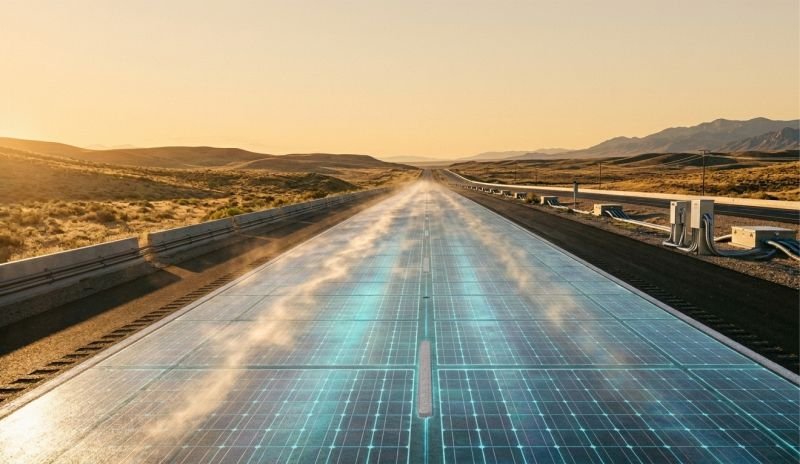






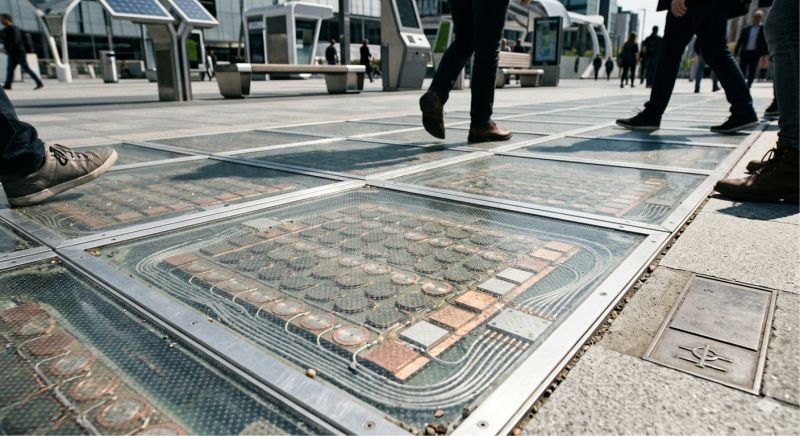
The floor of a busy underground station handles about thirty thousand footsteps on a winter morning. Each one drives a few hundred newtons of force into whatever is beneath it. Below the tiles, at roughly sixty centimeters of depth, the soil sits at twelve degrees Celsius, unmoved by what the air above does – whether it is minus eight or plus thirty. Both of these facts have been true for as long as the station has existed. Neither of them has ever powered a single lightbulb.
A piezoelectric-thermoelectric hybrid footpath is a concept device that changes both facts at once. Each section of pavement captures the mechanical pulse of every footfall through piezoelectric materials embedded in its structure, while a separate layer below exploits the temperature difference between the pavement surface and the stable substrate beneath through the thermoelectric effect. Two separate physics mechanisms, one surface, and an output that neither system could achieve alone.
The short version: A hybrid footpath combines piezoelectric transducers, which convert mechanical pressure into electricity, with thermoelectric modules, which convert a temperature gradient into electricity. In a busy transit corridor with a ten-to-fifteen kelvin temperature difference between the pavement surface and the subsurface, a square meter of this device could yield three to eight watts of continuous output – with the thermoelectric layer contributing the larger share, steadily, around the clock.
Key Takeaways
- The thermoelectric layer works continuously without any foot traffic – it runs on the temperature gap between the ground and the air above it
- The piezoelectric layer catches what the thermoelectric cannot: the sharp, intermittent mechanical pulses of human footsteps
- Neither layer alone justifies the engineering; together they share a substrate, reduce installation cost per watt, and flatten the output curve
- The biggest unsolved problem has nothing to do with the physics – it is the voltage, which arrives too small and too irregular to be useful without significant conditioning electronics
- If city-scale deployment ever happens, pavements stop being passive infrastructure and become distributed energy nodes – a shift in how engineers think about urban surfaces altogether
Table of Contents
Two Signals the Pavement Has Always Ignored
Most discussions about pavement energy focus on footstep harvesting and not much else. The heat beneath a city is a different conversation, usually held by geothermal engineers who have nothing to do with pedestrian infrastructure. What makes the hybrid footpath concept worth examining is the argument that both signals exist in the same square meter, at the same time, and ignoring one while chasing the other is an arbitrary constraint that no physics law requires.
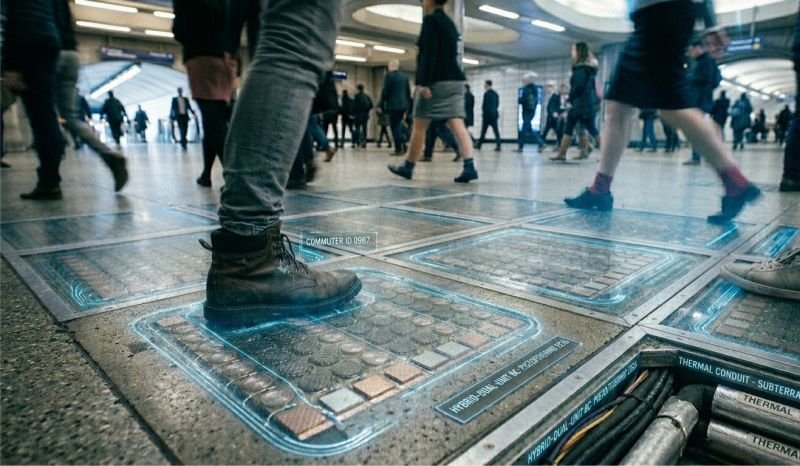
Foot traffic delivers pressure – variable, intermittent, tied to human schedules. The subsurface delivers temperature stability – continuous, independent of foot traffic, driven by the thermal mass of the Earth. These two signals have completely different characters. One is a spike. The other is a floor. A device that captures only the spike wastes the floor. A device that captures only the floor misses the one input that scales directly with the density of the city above it.
The synergy argument is not that two things are better than one. It is that both things are already there, and sharing a single installed substrate between them changes the economics of both. Installing a thermoelectric layer on its own beneath an urban street requires excavation, waterproofing, electrical routing, and surface reinstatement. Installing a piezoelectric array on its own requires the same work. Building one system that uses the same trench for both does not double the cost. That gap – between what the physics demands and what the civil engineering costs – is where the hybrid concept lives.
How the Hybrid Footpath Could Operate
The surface a pedestrian walks on is just the top of a layered system. In this device, what happens below that surface matters more than what happens at it.
The Piezoelectric Layer and What It Catches
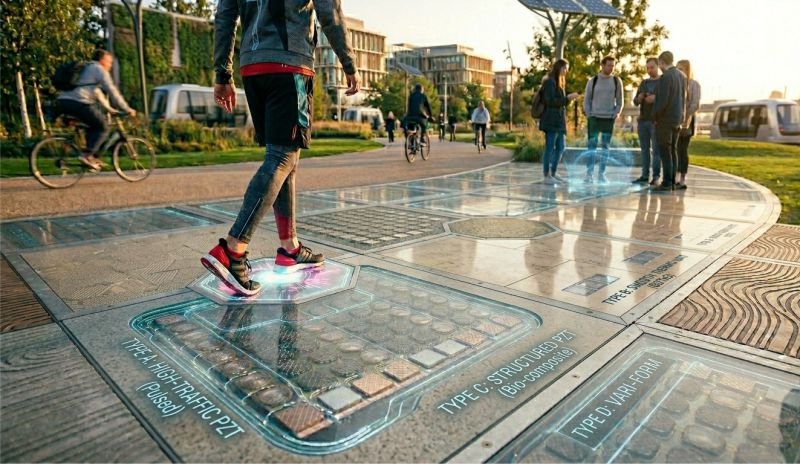
Directly beneath the load-bearing top surface sits a layer of piezoelectric transducers. Lead zirconate titanate ceramic – PZT – is the material most likely to appear here, given its high piezoelectric coefficient (d33 up to 600 pC/N) and mechanical stability under repeated vertical loading. PVDF polymer film is an alternative: more flexible, less brittle, easier to embed in curved surfaces, but with lower output per unit area. In a footpath, where the loading is vertical and the surface must remain rigid underfoot, PZT in tile form is the more plausible choice.
Each footfall compresses the piezoelectric layer by a fraction of a millimeter. The material responds by separating charge across its faces, converting mechanical deformation into electrical potential. The pulse is brief, typically two to five milliseconds per footfall, and the raw voltage can reach thirty to one hundred volts across a single transducer element before conditioning. The energy in that pulse is small – between fifty and two hundred millijoules per footstep per square meter – but it arrives in a continuous stream wherever real pedestrian traffic exists.
The Thermoelectric Layer and the Ground It Depends On
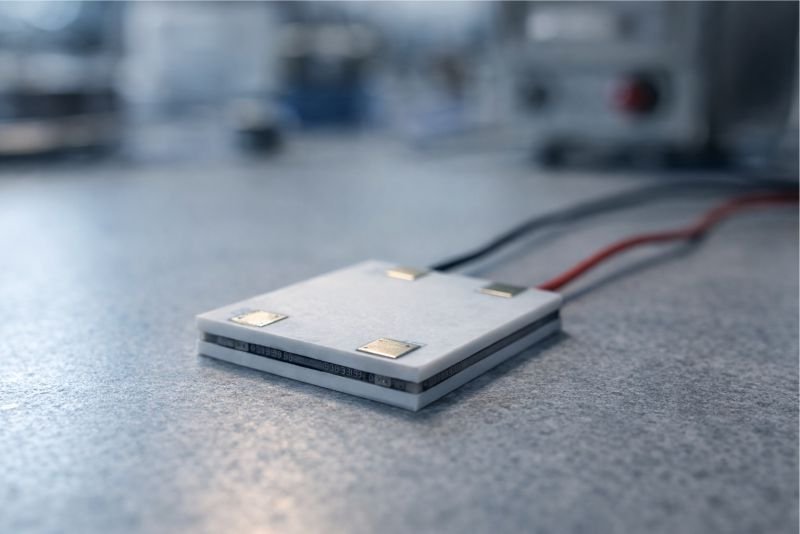
Below the piezoelectric layer, separated by thermal insulation on one side and thermally conductive material on the other, sits the thermoelectric module array. Bismuth telluride (Bi2Te3) is the standard material for near-ambient temperature differences: a Seebeck coefficient of roughly 200 microvolts per kelvin per thermocouple pair, combined with the lowest thermal conductivity achievable in a practical semiconductor at these temperatures.
The thermoelectric layer does not need a footstep to operate. It needs a temperature difference.
At sixty centimeters below a city pavement, soil temperature in a temperate climate sits between ten and fourteen degrees Celsius year-round, regardless of season. The pavement surface, exposed to weather, swings between minus ten and plus forty depending on the day. In midwinter, the subsurface is twenty to twenty-five kelvin warmer than the surface – heat flows upward through the thermoelectric layer and the modules generate current. In summer, the gradient inverts: the sun-heated surface is warmer than the cool substrate below, and heat flows downward. The modules still generate current. The polarity reverses, but a rectifier handles that. The thermoelectric effect requires only that the two sides of each module be at different temperatures – it does not care which side is hotter.
The Numbers From One Square Meter
The thermoelectric output follows the Seebeck equation:
V = S x ΔT x N
V is the open-circuit voltage. S is the Seebeck coefficient of a single thermocouple pair – approximately 0.4 mV/K for bismuth telluride. ΔT is the temperature difference between the module’s hot and cold faces. N is the number of thermocouple pairs in one module, typically 127 for a standard 40x40mm unit.
At ΔT = 15 K:
V = 0.4 mV/K x 15 K x 127 = 762 mV per module
Maximum power transfer occurs when load resistance equals internal resistance, typically 3-6 ohms for a standard module. At 4.5 ohms internal:
P_max = V² / (4 x R_int) = (0.762)² / (4 x 4.5) ≈ 32 mW per module
One square meter accommodates roughly 600 of these 40x40mm modules. At 32 mW each, the thermoelectric contribution reaches approximately 19 W/m² under this temperature difference. Real-world losses from imperfect thermal contact, pavement structure, and seasonal variation bring the practical figure closer to 3-8 W/m² in a well-installed system.
Add the piezoelectric contribution: in a transit corridor averaging 15,000 footsteps per square meter per day, at 100 mJ per footstep, the daily mechanical energy harvest is 1,500 joules – equivalent to roughly 0.42 kilowatt-hours per square meter per year. As a continuous average power: approximately 0.6 W/m². The thermoelectric layer contributes six to thirteen times more energy for the same surface area, continuously, without anyone walking across it.
| Piezoelectric Layer | Thermoelectric Layer | |
|---|---|---|
| Energy source | Footstep pressure (mechanical) | Temperature gradient (thermal) |
| Output type | Pulsed, high-voltage AC | Continuous low-voltage DC |
| Practical output (busy site) | ~0.5-1 W/m² | ~3-8 W/m² |
| Key material | PZT ceramic or PVDF film | Bismuth telluride (Bi2Te3) |
| Operational condition | Foot traffic present | Temperature difference present |
| Conditioning required | Full-bridge rectifier + boost converter | Boost converter only |
The numbers make the hierarchy clear: the piezoelectric layer is not the workhorse. It is the supplement. Its intermittent output does have one useful property, though – it correlates directly with pedestrian density, which means the same layer can serve as a real-time foot traffic sensor while simultaneously generating power.
Everything here is free. Readers are the reason it stays that way.
I make all of it alone, with no ads. If it is worth a coffee a month to you, that keeps the next one coming.
Keep it alive →The Voltage That Never Arrives Clean
There is a persistent gap between what the physics delivers and what electrical infrastructure can use, and in this device it is wide enough to matter.
The piezoelectric layer produces raw alternating current at voltages that swing unpredictably between near-zero and one hundred volts depending on walking speed, body weight, and footfall angle. A full-bridge rectifier turns that into rough DC. A boost converter then steps the voltage up to something stable – typically three to five volts for local sensor loads, or a regulated bus voltage for grid-tied applications. Each conversion step loses energy: a well-designed rectifier-boost chain might retain seventy to eighty percent of the original pulse energy, but in low-cost implementations the losses exceed fifty percent.
The thermoelectric layer is quieter but not simple. Its output at a fifteen-kelvin gradient is less than one volt per module – well below what any standard electrical system expects. Multiple modules must be wired in series to reach useful voltages, and the resulting string must then feed into a DC-DC boost converter to reach grid-compatible levels. The converter draws a quiescent current that can exceed the module’s output during low-gradient periods. At a ΔT below five kelvin – common in mild seasons – some thermoelectric installations consume more power in their management electronics than the modules produce.
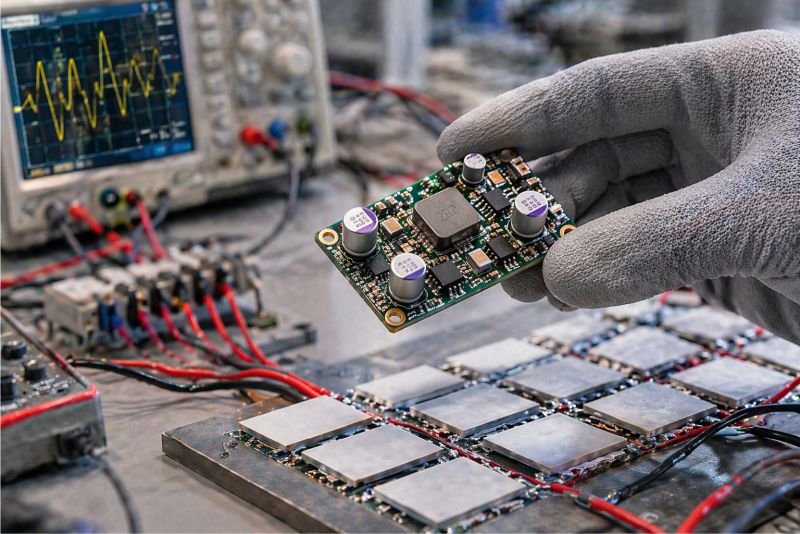
A hybrid footpath that feeds a local supercapacitor and powers LED pathway lighting or a wireless sensor node sidesteps this problem cleanly – the load is small and tolerant of irregular supply. A hybrid footpath trying to back-feed a city grid faces a more demanding architecture. The real engineering friction in this device is not the physics. The physics is fine. Both layers produce small, awkward voltages that require active conditioning to become useful, and the conditioning has a minimum power floor below which it stops being net-positive.
Which City Surfaces Make the Numbers Work
Not every pavement can carry this device. The physics is location-agnostic. The economics are not.
Why Transit Corridors Are Different From Parks
The thermoelectric layer needs a temperature difference. Any outdoor pavement has one – the question is whether the ΔT is large enough and stable enough to justify the installation. A shaded urban corridor, where the surface never heats above twenty degrees in summer and the subsurface stays at twelve, delivers a modest but continuous eight-kelvin gradient. A sun-exposed plaza in summer can reach forty-five degrees at the surface, giving a thirty-degree differential – but only during daylight hours and only in warm months.
The piezoelectric layer needs footsteps. A park path with two hundred footsteps per square meter per day produces negligible output. A metro station entrance, seeing twenty thousand footsteps per square meter per day, produces something worth harvesting.
The locations with both significant thermal gradient and high pedestrian density describe a fairly specific urban geography: subway mezzanines, underground shopping concourses, covered transit bridges, airport terminals. In all of these, the subsurface is thermally isolated from external weather, pedestrian density is reliably high, and the installation disruption can be managed against the existing maintenance schedule of the facility.
For a transit hub with eight hundred square meters of active hybrid footpath:
- Thermoelectric contribution: 800 m² x 5 W/m² = 4,000 W continuous
- Piezoelectric contribution: 800 m² x 0.7 W/m² average = 560 W
- Combined output: approximately 4,560 W – or 4.6 kW
Per year: roughly 40,000 kWh. Comparable to the annual electricity consumption of twelve average European households. That number will not power the station – a large underground station uses five to ten megawatts. But forty megawatt-hours per year covers installation costs in electricity value within a decade, from a surface that was going to be paved regardless.
The Case Against Photovoltaics at Ground Level
A horizontal photovoltaic panel at mid-latitude captures roughly 1,200 to 1,500 kilowatt-hours per square meter per year. At fifteen percent panel efficiency, that is 180 to 225 kWh/m²/year – an average of around twenty watts per square meter. The hybrid footpath manages perhaps thirty to sixty-five kWh/m²/year under good conditions, which is a significant deficit in raw output.
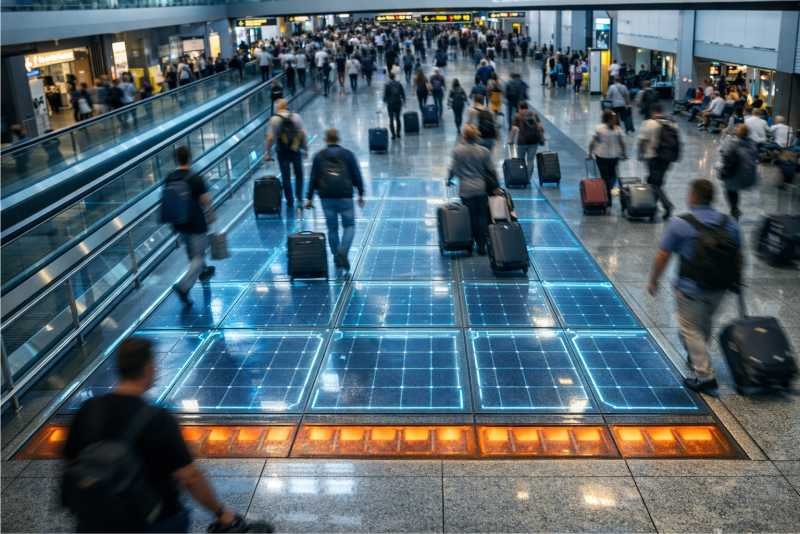
The comparison falls apart on location. A photovoltaic panel cannot be installed on the floor of an underground metro station, in a covered walkway, or on a pedestrian bridge beneath a highway. It cannot serve as a walking surface anywhere pedestrian safety is a concern. The hybrid footpath does not compete with photovoltaics for rooftops or open ground. It harvests from surfaces that have no solar option – and harvests something, from the energy passing through them every day.
What the Surface Looks Like After Installation
The engineering challenge at street level is invisibility.
A footpath tile that flexes noticeably underfoot, feels hollow, makes noise when loaded, or looks different from adjacent standard tiles will attract attention of the wrong kind – vandalism, unauthorized disassembly, and legal liability from trip hazards. The device must present as ordinary pavement. The load-bearing top layer is a rigid material – stone, ceramic, or reinforced composite – thick enough to distribute point loads from stiletto heels or wheelchair wheels across the piezoelectric layer below without exceeding its deformation tolerance. The active layers beneath must not create thermal hot spots visible to an infrared camera, must not trap moisture, and must survive the thermal cycling of a climate with freeze-thaw cycles.
Electrical connections between tiles cannot be surface-exposed. Any visible wire in a public space will be cut, pulled, or shorted within weeks. The connection architecture runs below the load layer, through sealed conduits, surfacing only at locked maintenance access points spaced at intervals across the installation area. The tiles communicate with local aggregation nodes through sealed low-voltage DC lines or wireless sensor protocols – neither of which requires surface penetration between tiles.
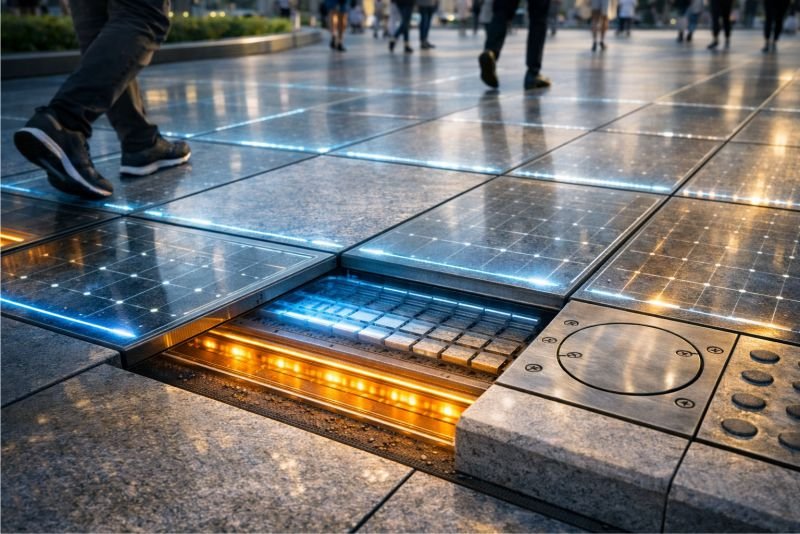
Ground-level heating is the slow failure mode most worth designing against, more so than cable theft. Metal-framed tiles in a sunlit summer plaza can reach temperatures that damage the thermoelectric layer’s solder bonds if the thermal interface between layers has no expansion tolerances designed in. Output monitoring catches it, but only if the monitoring system is actually running. An installation that degrades silently over three years before anyone notices is a more common real-world failure than sudden vandalism.
From Isolated Tile to Urban Energy Substrate
First Generation: High-Traffic Proof of Concept
The first deployable form of this device is a modular tile system installed in a specific, high-value location – a transit hub corridor, an airport terminal, a covered pedestrian bridge – where both the thermal gradient and the foot traffic justify the engineering. Each tile manages its own output, stores charge in an integrated supercapacitor, and feeds a local load: pathway LEDs, occupancy sensors, a wireless monitoring node. The grid connection is optional at this stage. The system proves its output figures and its durability under real conditions.
The energy output at this stage is local and small. That is appropriate. A first-generation device that claims grid-scale ambitions before proving tile-scale durability is a different kind of problem.
The Mature Form: Pavement as Distributed Infrastructure
When the tile technology reaches engineering maturity – better thermoelectric materials, more durable piezoelectric ceramics, integrated power conditioning that operates below one milliwatt of quiescent draw – the deployment logic changes. Individual tiles are no longer the unit of analysis. The installation area is.
A connected network of hybrid tiles across a metropolitan transit system produces something qualitatively different from what any single tile does. Each tile reports foot traffic data, surface temperature, and output power in real time. The network becomes a distributed sensor layer covering the physical space it occupies. Urban planners can read pedestrian flow patterns without cameras. Facility managers can detect subsurface temperature anomalies without excavation. Emergency services can track crowd density in real time through the floor itself.
At city scale, the energy contribution remains modest – a complement to conventional sources, not a replacement. The data value of a city-wide distributed sensor network embedded in its own walking surfaces may eventually exceed the value of the electricity it generates. The pavement stops being passive infrastructure and becomes the lowest layer of a city’s information architecture, powered by the city walking across it.
The View From NoSuchDevice
What pulls me toward the concept is the change in behavior once heat enters the pavement as a second source. Footsteps alone give the surface a jagged pulse, tied to crowds, rush hours, and empty intervals between them. The thermoelectric layer changes the tempo. Energy begins to arrive even when nobody is walking. Under a busy concourse, pavement turns into a surface with two rhythms at once: the quick mechanical strike of passing bodies, and the slower thermal exchange between air, tile, and ground.
Another part keeps growing in importance the longer I look at the numbers. Electricity may end up being only one half of the story. A field of hybrid tiles could also read movement, pressure, and thermal drift across an entire corridor. In a metro station or airport terminal, floor space already carries the map of human circulation. Hybrid pavement would finally make part of that map visible, quietly, continuously, and without asking every decision to come from cameras hanging overhead.
Physics does not look like the weak point here. Piezoelectric materials exist. Thermoelectric modules exist. Power conditioning exists. The real difficulty sits inside the tile itself, where durability, sealing, thermal contact, wiring, and cost have to survive in one compact assembly. Public flooring lives a hard life. Water gets in. Expansion joints move. Loads arrive at awkward angles. Maintenance windows stay short. A concept like this reaches maturity only when all of that pressure can be absorbed without the system turning fragile or expensive.
Deployment also has a natural geography. The first serious installation belongs in a place where traffic is dense, maintenance access already exists, and thermal conditions remain useful for most of the year. An airport concourse makes sense. A metro interchange makes sense. A covered pedestrian corridor makes sense. In ground like that, the hybrid footpath begins to read like real infrastructure: modest in output, rich in function, and strong enough to justify its place under thousands of ordinary steps.
You read the whole thing.
That is rarer than it should be, and it is the exact kind of attention I built this archive for. I make every piece alone, with no ads and no investor deciding what gets written. If you want the next machine taken apart like this one, you can help me make it.
A coffee a month is enough to keep it free for everyone.
Prefer crypto or a one time gift? Other ways to give →