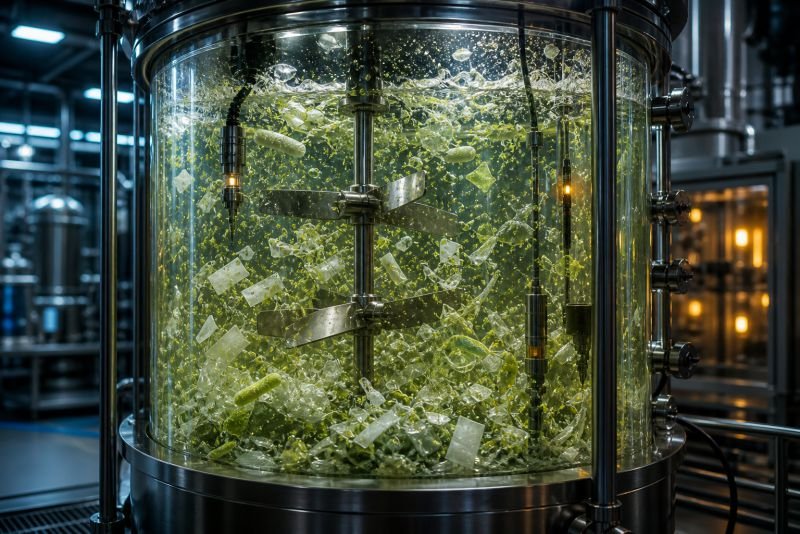






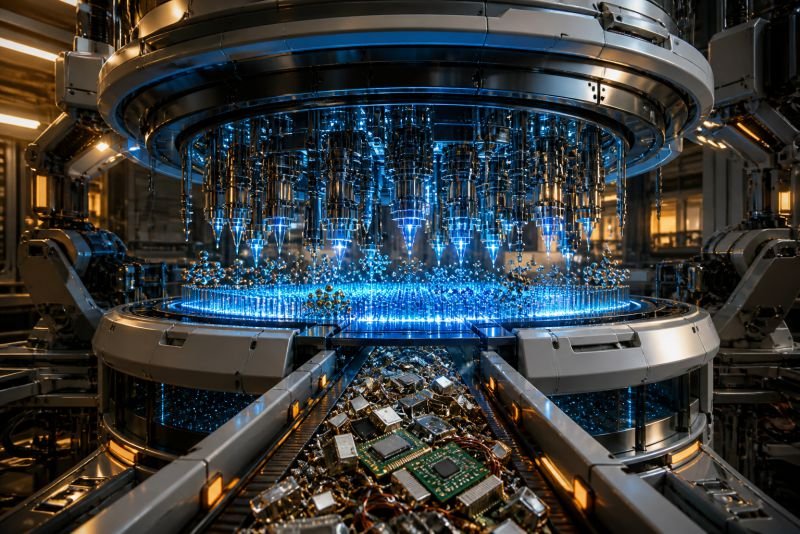
There is a specific grade of gold used in semiconductor manufacturing. Five-nines purity – 99.999 percent – achieved through cascading refinery steps: ore extraction, electrolytic refining, zone melting. Each step costs energy and generates waste. That gold ends up bonded to a chip inside a device discarded in a few years. When it enters classical recycling, what comes back is 99 percent purity at best – assuming careful handling. The four extra nines that cost so much to create dissolve away in the process.
This is not a failure of recycling technology. It is a consequence of scale. Every recycling method operates at the wrong level – molecular at the finest, bulk material at the worst. The information embedded in atomic arrangement, the precision that manufacturing spent enormous energy to achieve, disappears the moment material enters any known recovery process.
A quantum recycling machine operates at the level where that precision lives.
The short version: A quantum recycling machine scans any waste material at atomic resolution, identifies every atom by element and position, disassembles the material bond by bond, and reassembles the recovered atoms into specified pure materials. One tonne of mixed electronic waste contains roughly 300 grams of gold – approximately $30,000 at current prices – plus silver, copper, cobalt, and rare earths. Classical processes recover 80 to 90 percent of the gold using toxic acid chemistry. Atomic-level recovery approaches 100 percent of every element present, with no toxic byproduct. The physics of atomic manipulation is experimentally confirmed. The machine is the engineering challenge.
Key Takeaways
- Classical recycling destroys atomic-level precision the moment it begins – this machine operates at exactly the scale where that precision is preserved
- Scanning tunneling microscopes have moved individual atoms since 1989; the physical principle of atomic manipulation is not theoretical
- For e-waste, gold recovery alone generates roughly $30 per kilogram of input – enough to justify the energy cost many times over
- Quantum decoherence is the central engineering obstacle – the machine’s operating environment must suppress thermal noise at the nanoscale
- Industrial throughput requires millions of atomic manipulation probes operating in parallel, each handling a small region of the input stream simultaneously
Table of Contents
What Recycling Cannot Do at Any Scale
Something happens when materials mix that no engineering has fully reversed. Entropy increases. Two elements that started in separate, pure states become statistically distributed throughout a combined volume, and pulling them apart again requires work proportional to how thoroughly they have mixed. This is not a problem that better equipment or smarter chemistry solves. It is a consequence of the second law of thermodynamics.
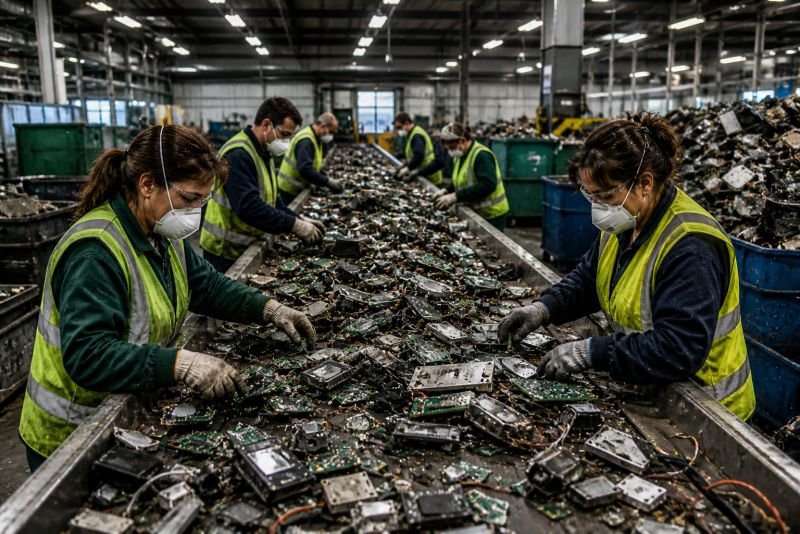
Current separation technologies work around this in various ways. Magnetic sorting extracts ferrous metals from other materials. Density separation uses water or air to segregate by weight. Hydrometallurgy dissolves specific metals into solution and precipitates them back out. Each approach works when materials are coarsely mixed – glass from plastic, aluminum from steel. Each fails when materials are intermixed at molecular or atomic level.
A circuit board is an extreme case of this problem. Gold contacts sit on copper traces embedded in epoxy substrate, soldered with tin-silver alloy, bonded to silicon dies coated in silicon dioxide, wrapped in flame-retardant polymers. The elements are chemically bonded and physically interlocked at scales no mechanical separation can reach. Hydrometallurgical processing can dissolve the gold with sulfuric acid and cyanide, but it generates a toxic waste stream, cannot cleanly separate every element, and loses material to contamination at each step.
The constraint is not engineering competence or budget. The constraint is the scale at which the work is being attempted.
Why Quantum Recycling Is Not a Marketing Term
When technology companies attach “quantum” to a product, the word usually means “advanced” and nothing more specific. For a recycling machine operating at atomic level, it is precisely the right word – and understanding why matters for understanding the device.
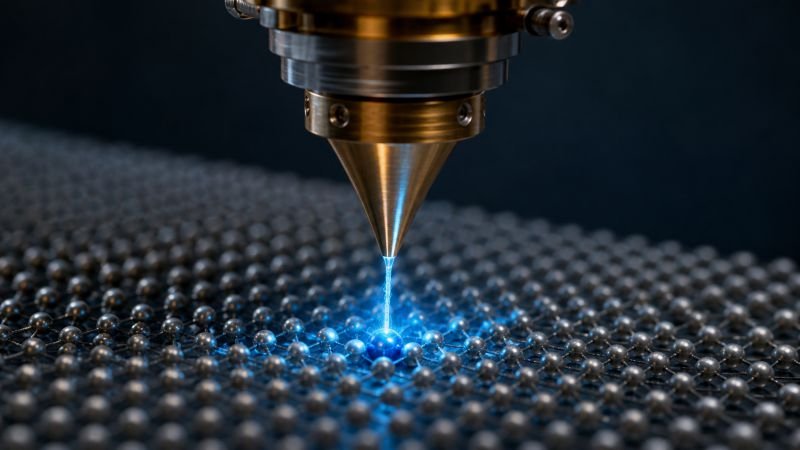
Classical chemistry works at molecular level. It breaks and forms chemical bonds, rearranging collections of atoms into different collections. What it cannot do is address individual atoms selectively within their molecular context. If a gold atom is embedded in a complex organic-metal compound, classical chemistry degrades the compound into smaller fragments, but where the gold atom ends up is determined by statistical outcome, not by deliberate placement.
Quantum mechanics governs matter at atomic and sub-atomic scale. At this level, the behavior of atoms is described by wave functions and quantum states, not by the bulk properties that classical physics tracks. A device operating at quantum scale does not break bonds as a side effect of heat or chemical reaction – it interacts with the quantum state of specific atomic bonds directly. The selection of which atom to move and where to place it is deterministic.
The foundational physics behind this is covered in the archive’s science principles article The Role of Quantum Mechanics in Future Technologies. What matters specifically for this machine is the experimental confirmation. In 1989, IBM researchers used a scanning tunneling microscope to position 35 individual xenon atoms on a nickel surface, spelling out the company’s name. Each atom was moved deliberately, one at a time. That result has been replicated with many different elements and surfaces in the decades since. Atomic-scale manipulation is not a prediction. It is a 35-year-old laboratory routine.
The gap between a laboratory demonstration and an industrial machine is where the engineering work lives. The physics is not in question.
How the Quantum Recycling Machine Operates
The machine works in three sequential phases: reading the atomic structure of the input material, disassembling it with bond-level precision, and rebuilding the recovered atoms into specified output materials. Each phase is grounded in established physics. Each phase is an engineering challenge at industrial scale.
Phase One: Mapping Every Atom in the Input Stream
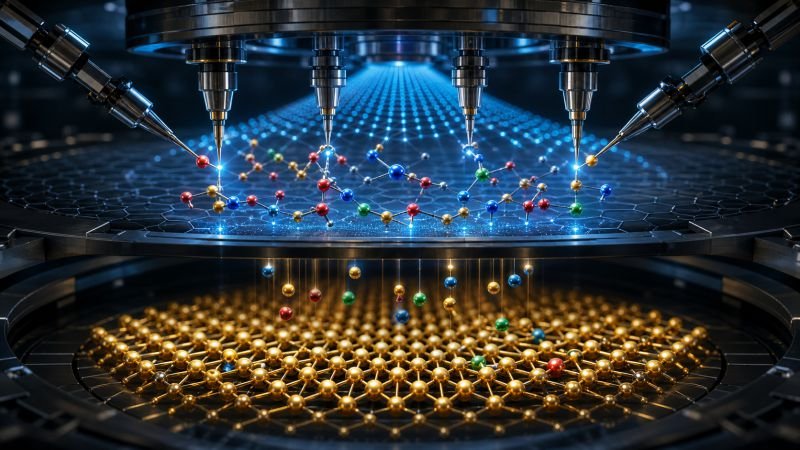
Before the machine sorts atoms, it needs to know what it has. Scanning tunneling microscopes read atomic surfaces by passing a conductive probe tip within a nanometer of the material – close enough for quantum tunneling current to flow between tip and surface. Variations in that current reveal the positions and identities of individual atoms. A laboratory STM maps a surface of a few thousand atoms in minutes.
The quantum recycling machine runs this process across millions of probes simultaneously, each reading a small region of the input stream. Every individual probe operation follows the same physics. The scale is the engineering leap – fabricating a probe array at that density and coordinating the readout without signal interference is where most of the hardware development sits. What the phase produces is a complete atomic map of the input material: every element identified, every position recorded, before a single bond is broken.
Phase Two: Breaking Bonds Without Breaking the Method
With the atomic map complete, the machine proceeds to selective disassembly – and this step is categorically different from melting, dissolving, or any classical destructive process.
The machine delivers energy to specific atomic bonds at the precise frequency required to break them, leaving adjacent bonds intact. Breaking a covalent carbon-carbon bond in a polymer requires approximately 3 to 4 electron-volts delivered to that specific bond location. A metallic bond in a copper-gold alloy requires around 2 to 3 eV. At each position, the machine consults the atomic map, identifies the bond type present, and delivers the exact energy dose. What this produces is a sorted population of atoms at known positions. Material loss in this step, if the machine is functioning correctly, approaches zero.
Phase Three: Reassembly From the Material Library
Sorted atoms reassembled in random configurations produce nothing useful. Reassembly requires a target specification – a material library: a database of precise atomic arrangements defining specific output materials. The crystal lattice spacing of high-purity copper. The molecular geometry of a pharmaceutical compound. The doping profile of semiconductor-grade silicon.
From a stream of sorted elemental atoms, the machine builds these structures the way a 3D printer builds from a CAD file, but at atomic resolution and with no tolerance for approximation. The AI control layer managing this process is not an optional enhancement – it is a functional prerequisite. The number of simultaneous decisions required per second, which atom goes to which position in what order at what approach angle and energy level, exceeds any pre-programmed fixed sequence by many orders of magnitude. A quantum recycling machine without that computational layer produces sorted elemental streams at best, not specified output materials.
Everything here is free. Readers are the reason it stays that way.
I make all of it alone, with no ads. If it is worth a coffee a month to you, that keeps the next one coming.
Keep it alive →The Energy Bill for Atomic Disassembly
The thermodynamic argument cannot be bypassed. Breaking bonds requires energy, and the economics of the machine depend entirely on what goes in.
The theoretical minimum energy to break all atomic bonds in one kilogram of mixed polymer runs to approximately 13 to 26 kilowatt-hours – derived from the bond energy of typical carbon-carbon and carbon-hydrogen bonds at 3 to 4 electron-volts each, multiplied by the moles of bonds per kilogram. Real-world device efficiency losses push actual consumption higher. A reasonable working estimate for the machine sits around 50 to 150 kWh per kilogram processed.
The viability condition for any input material follows directly:
V_m / C_e > E_d
Where V_m is the value of recovered materials per kilogram of input, C_e is electricity cost per kilowatt-hour, and E_d is the processing energy required per kilogram.
For mixed plastic waste, V_m is approximately $0.10 to $0.20 per kilogram – the commodity value of recovered carbon, hydrogen, and oxygen atoms. At $0.05/kWh industrial electricity, the machine can spend at most 2 to 4 kWh per kilogram and break even. The estimated 50 to 150 kWh actual requirement places mixed plastic outside favorable economics, unless the electricity source approaches zero marginal cost and the alternative is permanent landfill liability.
For electronic waste, the arithmetic reverses completely. One tonne of circuit boards contains approximately 300 grams of gold, 3.3 kilograms of silver, and 130 kilograms of copper. At current gold prices near $100 per gram, that is $30,000 in gold per tonne – $30 per kilogram of input. The machine can spend up to 600 kWh per kilogram and still recover its energy cost from gold alone, before accounting for any other recovered element.
| Input Material | Classical Recycling Output | Quantum Recycling Machine Output |
|---|---|---|
| Mixed plastics | Downcycled dark plastic pellets | Pure carbon, hydrogen, oxygen – energy economics unfavorable |
| Circuit boards (e-waste) | 80-90% gold recovery, acid waste stream | Near-100% of all elements, zero toxic byproduct |
| Li-ion batteries | 40-60% lithium recovery | Full lithium, cobalt, nickel, manganese recovery |
| Mixed glass | Color-contaminated cullet | Pure silicon dioxide or separated elements |
| Medical waste | Incineration | Separated organic molecules and elemental recovery |
| Low-level radioactive waste | Centuries of secure geological storage | Isotope separation, stable elements recovered |
The Decoherence Problem and What One Wrong Atom Does
Quantum states are not robust. In a perfect vacuum near absolute zero, they are stable for measurable periods. At room temperature, surrounded by vibrating atoms, electromagnetic fields, and thermal noise, quantum coherence collapses in picoseconds to nanoseconds. A quantum system in that environment loses its quantum properties almost immediately – which means the precision of atomic manipulation degrades into statistical approximation before most operations can complete.
The quantum recycling machine addresses this through two converging approaches: operating conditions that suppress decoherence, isolating the manipulation zone from thermal and electromagnetic noise, and manipulation techniques fast enough to complete each atomic operation before coherence has time to collapse. The right combination of both defines the machine’s operating envelope, and finding it is where a substantial portion of development effort concentrates.
Error rates in the reassembly phase produce consequences that scale sharply with the application. In structural steel, a positional error rate of 0.001 percent is irrelevant – bulk mechanical properties are unaffected. In a pharmaceutical molecule of 10,000 atoms, one misplaced atom creates a structural isomer with potentially different biological activity. The acceptable error rate varies by seven orders of magnitude across possible output materials. The machine does not operate at a single tolerance – it runs across a range of precision modes, each calibrated to the requirements of its target output.
The biological comparison is instructive. Bacteria have been disassembling organic matter and reassembling its atoms into new biological structures for approximately 3.8 billion years. The error rate in DNA replication is roughly one error per billion base pairs, achieved through multiple layers of proofreading mechanisms – polymerase proofreading, mismatch repair enzymes, molecular chaperones. This accuracy took hundreds of millions of years of evolutionary pressure to develop across a narrow range of molecular species. The quantum recycling machine engineers equivalent precision deliberately, across a far wider range of atomic species and target structures. Whether that reads as the hard part or as the interesting design challenge depends on how seriously you take what evolution managed with no blueprint at all.
From E-Waste to Radioactive Residue: Where the Machine Becomes Irreplaceable
Applications for the quantum recycling machine follow a clear hierarchy: the higher the recovered material value and the fewer the existing alternatives, the stronger the case for deployment.
E-waste sits at the favorable end of both criteria. Material value per kilogram is high enough for the energy economics to work, and the classical alternatives produce toxic acid waste alongside incomplete recovery. The development arc for the machine starts here – not because e-waste is the most impressive application, but because it is the one where investment returns justify development cost. A laboratory proof-of-concept demonstrating single-element recovery from a binary alloy is stage one. An industrial pilot focused on precious metals from circuit boards follows. Expansion to general e-waste streams as hardware efficiency improves comes next.
Mixed waste – an unsorted stream containing plastics, metals, glass, and organics together – is where the machine has a structural advantage over every classical method. Classical recycling requires pre-sorted input streams, and contamination in mixed waste destroys the economics of every downstream process. The quantum recycling machine performs sorting during disassembly. Pre-sorting becomes operationally irrelevant when sorting happens at atomic resolution.
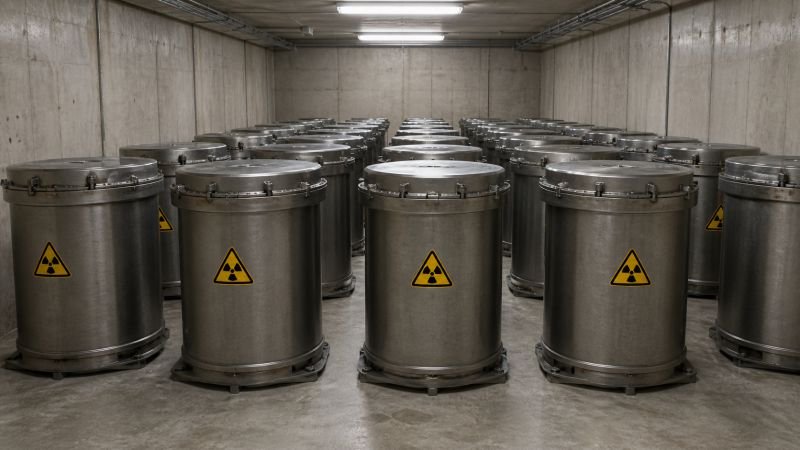
Radioactive waste is the endpoint application, and the one where no alternative exists at any price. Low-level radioactive waste goes into secure geological storage, where it remains a liability for hundreds to thousands of years. The core problem is isotopic: radioactive cesium-137 and stable cesium-133 are chemically identical. Classical chemistry cannot distinguish them. The quantum recycling machine operating at atomic level distinguishes them by nuclear mass – the only physical difference between isotopes – and sorts them accordingly.
If the separation holds, it converts centuries of storage obligation into a one-time processing event. The radioactive fraction concentrates into a smaller, more manageable volume. The stable fraction is recovered as clean material. The nuclear industry would pay essentially any cost per kilogram for a machine that does this reliably. The physical principle enabling isotope separation at atomic scale is identical to the principle handling e-waste. Same machine. Different operating mode.
The View From NoSuchDevice
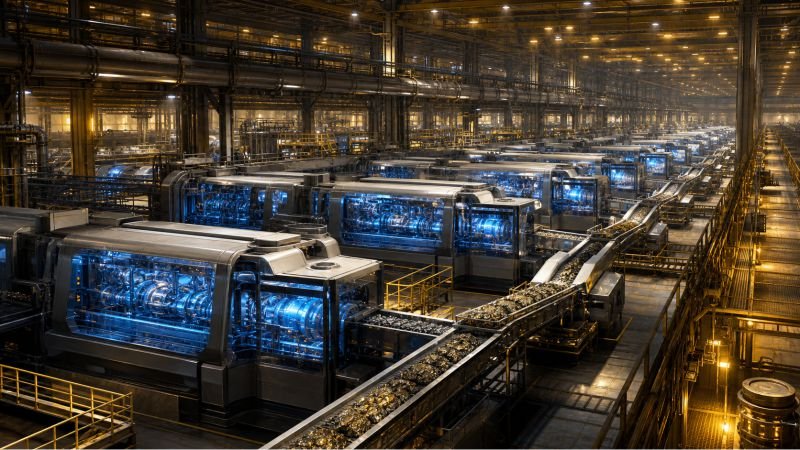
I think the framing of “quantum recycling machine” is accurate and slightly too modest at the same time. Accurate because recycling is the first application the economics support and the most obvious entry point. Slightly too modest because a device that reads any material at atomic resolution, disassembles it to constituent elements, and reassembles those elements according to a specification is not, in any meaningful sense, limited to recycling. It is a matter compiler. Recycling is the first thing it gets built to do. The second and third things are considerably more consequential.
Whether the decoherence problem gets solved at industrial scale – that is the question I find genuinely difficult to think around. The adjacent fields are all moving in the right direction: quantum computing is developing coherence suppression techniques, molecular nanotechnology is producing atomic-scale mechanical systems, materials science is finding substrates where coherence persists longer at higher temperatures. Whether those fields converge on a usable architecture before the waste crisis closes the relevant window is not a question I can answer honestly.
What I do think matters is simpler. Every physical operation this machine requires – reading atomic position via quantum tunneling current, breaking specific bonds with targeted energy delivery, placing individual atoms at specified positions – has been demonstrated in a laboratory for specific atoms under controlled conditions. The gap between that and a machine processing tonnes per day is enormous. But it is an engineering and scale gap, not a physics gap. That distinction is worth holding carefully. The machine already has its shadow in physics. The archive exists for exactly that kind of shadow.
You read the whole thing.
That is rarer than it should be, and it is the exact kind of attention I built this archive for. I make every piece alone, with no ads and no investor deciding what gets written. If you want the next machine taken apart like this one, you can help me make it.
A coffee a month is enough to keep it free for everyone.
Prefer crypto or a one time gift? Other ways to give →